Vishnu descended as the perfect man — the prince who kept every promise, the exile who built bridges, the king whose name itself became the mantra of millions.
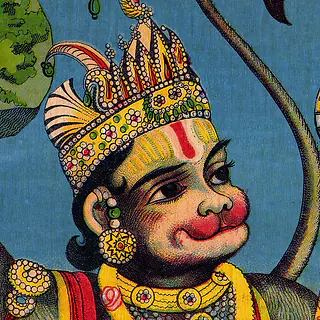
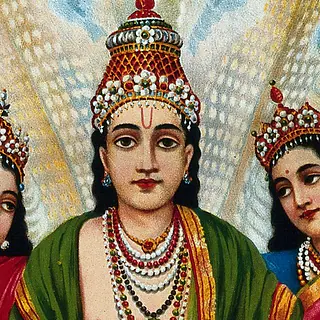
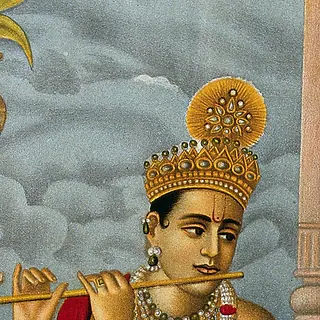
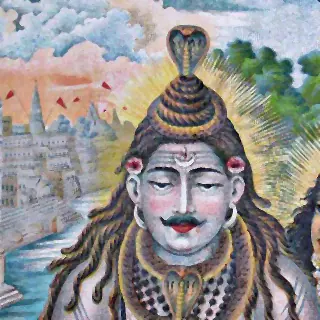
Rama Panchayatan — Raja Ravi Varma, before 1906 (lithograph)
✦ In the simplest words
Rama is the prince of Ayodhya who always did the right thing, even when it was the hard thing — he went to the forest for fourteen years just to keep his father's word. With Hanuman and an army of vanaras he defeated the ten-headed Ravana and brought Sita Ma home. Diwali's lamps still light his way back.
Why Rama is God
Rama is dharma given a biography. Where scripture states principles, the Ramayana walks one life through every collision a principle can meet — duty against desire, promise against comfort, kingship against love — and shows the cost of choosing rightly, paid in full and without complaint. His title says it exactly: Maryada Purushottama, supreme among men in keeping the boundary-lines. He is worshipped not for wielding infinity but for refusing, at every fork, the easy road: the avatar whose miracles are mostly made of character.
And then there is the Name. From Valmiki's Sanskrit to Tulsidas's Awadhi, from Kabir's couplets to Gandhi's last breath, 'Rama' detached from the story and became the tradition's most-spoken mantra — taraka, 'the one that ferries across'. The tradition even says the name outweighs the named: what Rama crossed the ocean to do with an army, the name does daily in ordinary hearts. Greeting, consolation, dying word — Ram-Ram is India speaking dharma in two syllables.
Origins — where the story begins
The Ramayana of Valmiki — the adi-kavya, poetry's own firstborn — tells his advent. King Dasharatha of Ayodhya, sonless for decades, performed the putrakameshti yajna; from its fire came a vessel of payasa, and of the queens who shared it Kausalya bore Rama on the noon of Chaitra's ninth day, under Punarvasu — the moment Ram Navami still keeps to the hour. Heaven's ledger stood behind the birth: Ravana had extorted invulnerability against gods and demons but, in contempt, left men off the list. Vishnu therefore chose to arrive as the thing tyranny forgot to fear: a man.
The tradition then retold him in every tongue it owns — Kamban's Tamil, Krittivasa's Bengali, Eknath's Marathi — until Tulsidas's Ramcharitmanas made the north's every courtyard a recitation hall. The tellings vary in episode and emphasis, and the tradition holds them honestly as one truth in many mirrors: somewhere between history remembered and heaven narrated stands a prince whose account survives because no generation could afford to lose it.
Why they come
Rama descended to prove a hypothesis the age had begun to doubt: that dharma is livable. Any god can be perfect with omnipotence switched on; Rama's mission required its renunciation — to face exile, loss, war and impossible royal dilemmas with only the tools available to any human: truth, courage, patience and kept promises. His victory over Ravana is the visible plot; the deeper purpose was the demonstration — a standard, set in human materials, that a person and a kingdom (Ram Rajya remains the word for just governance) can actually meet. He is the answer to 'but is it possible?' — lived once, so it stays askable never again.
Every symbol, explained
The attributes the tradition gives them — and what each one means. Not every attribute appears in the painting above; all of them live in the temples and prints.
The kodanda (bow)
Strength strung to duty: drawn rarely, never for himself.
One arrow, one word
The proverb of his character — Rama does not need a second of either.
The green of the forest years
Fourteen years of exile worn without bitterness — hardship as ornament.
Sita at his left, Lakshmana at his right, Hanuman at his feet
The complete murti is a family and a devotee — his divinity is relational.
The paduka (sandals)
Bharata ruled fourteen years in their name — authority belongs to dharma, not to presence.
The tales of Rama
The great stories, told in full — with their sources named. Use the arrows or pick a tale.
The morning the crown became exile
Tale 1 of 4
Ayodhya slept decorated for a coronation. By dawn, through an old boon Queen Kaikeyi called in, the same prince was to be exiled fourteen years, barefoot, to the forest. The court wept, the city wept, Dasharatha collapsed under his own given word — and the scripture slows down to study one face that did not change. Valmiki says Rama received the exile as evenly as he had received the crown: the same bow, the same voice, the same morning.
His reasoning, offered gently to raging Lakshmana, became the tradition's spine: a father's word is not weighed against its consequences; dharma is not dharma only when convenient. He dressed in bark, smiled at Ayodhya, and walked out — and by evening the empire discovered what it would spend fourteen years learning: the throne had followed the walker. Bharata refused the crown, placed Rama's sandals on it, and governed as their servant. Kingship, the episode rules, is character; geography is incidental.
Told in: Valmiki Ramayana, Ayodhya Kanda
What Rama teaches
A promise is a place you live
Fourteen years for one sentence of his father's. Keep your word at the small scale — arrival times, returned calls — and the large scale will hold.
Equanimity is royalty
Crown and exile in one morning, one face. Rehearse receiving good and bad news with the same first breath.
Judge offerings by love, not polish
He rated bitten berries above royal feasts. Receive people's imperfect efforts by their intent — and offer yours whole-hearted, however small.
Build bridges, name every stone
Impossible distances cross by many small floated contributions. Credit the squirrels; teams that are thanked can walk armies across oceans.
Learn even from fallen enemies
Lakshmana at Ravana's feet is the tradition's boldest classroom. Extract the lesson from every opponent — their knowledge outlives your quarrel.
How to learn from Rama — this week
1
Take a Rama-vrata on your word: for one month, make no commitment you will not keep, and keep every one you make — recalibrate how you promise.
2
Practise the even face: before reacting to any news, one slow breath and 'Shri Ram' — the pause where equanimity is built.
3
Serve someone the world overlooks — an elder, a cleaner, a junior — with Shabari-grade attention, and receive their offerings with Rama-grade respect.
4
Keep Ram-nama as your default idle sound — walking, waiting, worrying: the taraka mantra that ferried Gandhi through a bullet can carry your Tuesday.
Their names, and what they mean
Maryada Purushottamathe supreme man of righteous boundaries
Raghunandanjoy of the Raghu dynasty
SitapatiSita's lord — his first identity in devotion
Kodanda-RamaRama of the bow, the guardian form
Patita-pavanapurifier of the fallen — Ahalya's and everyone's
Ram Lallathe infant Rama — Ayodhya's own darling address
Family & relations
Son of Dasharatha and Kausalya; husband of Sita — Lakshmi descended, found in a furrow; brother of Bharata, Lakshmana and Shatrughna, each a study in devotion; father of Lava and Kusha, who first sang the Ramayana. And by adoption of the heart: Hanuman, whose chest carries the whole family engraved.
Their days
Ram Navami is his birthday to the hour (Chaitra's ninth, at noon); Dussehra his victory and Diwali his homecoming — and every day is his in the greeting 'Ram-Ram'.
These histories are retold faithfully from named scriptures and living tradition, and regional tellings are honoured where they differ. Like all religious content on Dharamkira, they await final review before public launch.