Son of the wind, servant of Rama — the strongest being in creation who never once used his strength for himself, and the nearest god when fear is at the door.
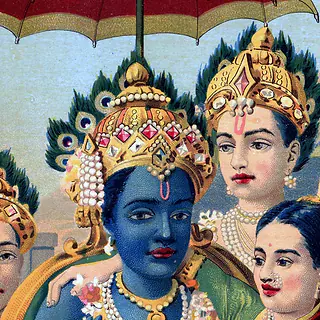
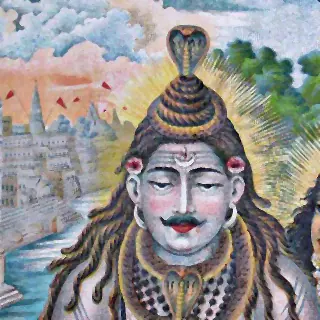
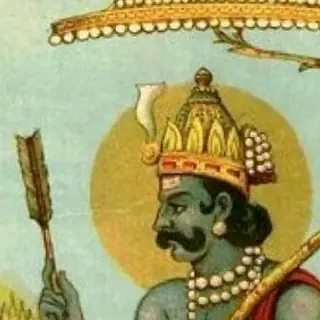
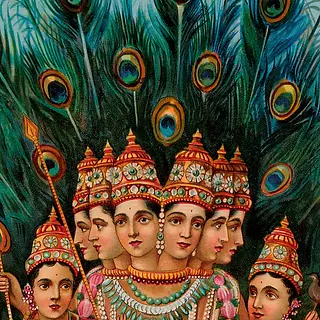
Hanuman carrying the herb-bearing mountain — Ravi Varma Press, 1910s
✦ In the simplest words
Hanuman ji is the mighty vanara who can fly, lift mountains and never gets tired — but the amazing thing is WHY he's strong: only to help. He jumped an ocean for Rama, carried a whole mountain to save Lakshmana, and when you're scared at night, his name is the one that makes fear run away.
Why Hanuman is God
Every other god must balance power against something; Hanuman's power needs no balancing because it is already owned by service. He is shakti with zero self-interest — the tradition's proof that strength becomes infinite exactly when it stops being for oneself. Rudra's own fierce energy born in vanara form, raised by the wind, blessed by every god, and then given, whole, to Rama: the mightiest being in the epic spends the epic doing errands, and turns errands into scripture.
His second gift is the conquest of fear. Bhoot-pishach nikat nahin aave — the Chalisa's promise that no dark thing approaches where his name sounds — has been whispered by more frightened children than any verse in any language. He is also the tradition's chiranjivi scholar: grammarian, singer, diplomat, the first reader of the Ramayana and, tradition says, still present wherever it is sincerely sung — the immortal proof that devotion, strength and intellect were never meant to be separate departments.
Origins — where the story begins
He is born of wind and fire-of-Shiva. Anjana, a celestial dancer in vanara form, worshipped Shiva for a son; Vayu, the wind god, carried into her a portion of Rudra's own energy — and the child arrived already impossible: minutes old, he took the rising sun for a ripe mango and leapt for it. Indra's thunderbolt struck the flying infant's jaw (hanu — hence Hanuman), and the wind god, in grief, withdrew the breath from all creation until every god came with a gift: strength beyond measure, speed of thought, immunity to fire and water, life at will. The infant woke more blessed than any being had ever been.
Then came the curse that is really the key to his character: the boy used his powers for cosmic mischief — swallowing ashram fires, tying sages' beards — until a rishi sealed the memory of his own strength: he would forget what he could do until someone reminded him in the hour of dharma's need. So the mightiest of beings grew up humble by amnesia, and the tradition received its favourite mechanism: Hanuman's greatness must always be awakened by another's faith in him — as Jambavan would do at the ocean's edge, and as every devotee reciting his deeds does again.
Why they come
Hanuman exists to be the bridge between longing and reunion. In the Ramayana's architecture he is sandesh-vahak — the carrier: of Rama's ring to Sita's despair, of Sita's jewel to Rama's hope, of the mountain to the dying, of the news of victory to the waiting. Where Rama is the ideal and Sita its endurance, Hanuman is the movement between them — devotion with wings. His continuing office, the tradition holds, is the same in every devotee's life: he carries strength to wherever faith has collapsed, guards those who take the Name, and demonstrates permanently that the fastest route to the divine is not climbing above others but kneeling lower than your own gifts.
Every symbol, explained
The attributes the tradition gives them — and what each one means. Not every attribute appears in the painting above; all of them live in the temples and prints.
The gada (mace)
Authority carried, never flaunted — resting on his shoulder like a farmer's tool.
The open chest with Sita-Rama within
Asked for proof of devotion, he tore open his chest — identity itself replaced by the beloved.
The mountain on his palm
When you can't identify the medicine, bring the whole mountain — completeness of effort over cleverness.
Sindoor covering his body
Told a pinch of sindoor was for Rama's long life, he bathed in it — devotion does not do arithmetic.
The tail — weapon, seat and torch
In Lanka's court it coiled into a throne higher than Ravana's; set alight, it burned the golden city — improvisation as grace.
Folded hands before Rama
The complete image: infinite power in the posture of asking what needs doing.
The tales of Hanuman
The great stories, told in full — with their sources named. Use the arrows or pick a tale.
The leap of remembering
Tale 1 of 4
The search party stood defeated at land's end: Sita found — but across a hundred yojanas of sea no bear or vanara could cross. The company sat down to die of shame. Then old Jambavan turned to the quietest member, sitting apart, and began simply to remind: son of the wind, do you not know what you are? He recited the infant's sun-leap, the boons, the sealed memory — and as he spoke, Hanuman began to grow.
The Sundara Kanda opens with that growth — the forgotten self returning until a mountain shook under his foot as he leapt. Mainaka rose from the sea offering rest: declined mid-flight, work before comfort. Surasa the serpent-mother demanded he enter her mouth: he ballooned vast, then shrank to thumb-size, darted in and out, courtesy and cleverness satisfied together. The shadow-demon Simhika he ended in one stroke. The tradition reads the whole crossing inward: everyone's strength is under a seal of forgetting, and the holiest work a friend can do is Jambavan's — recite to people what they are until they grow.
His entire biography uses power only outward. Audit your own strengths: whatever serves only you is still asleep.
Let others wake your seal
He forgot his powers until reminded. Stay close to Jambavans — people who recite you to yourself — and be one for somebody.
Bring the mountain
Unsure which detail matters? Deliver completeness. In care, in work, in rescue — love errs on the side of everything.
Decline Mainaka mid-task
Rest offered in the middle of a vow is a test wearing courtesy. Thank it, touch it, keep flying.
Sing your way to strength
The Chalisa works as his biography recited — courage installed by repetition. Keep verses of power on your tongue for the corridor moments of fear.
How to learn from Hanuman — this week
1
Do one anonymous act of strength daily — carried luggage, a covered shift, a defended absent colleague — signed, like all his work, only with the master's name.
2
On Tuesdays or Saturdays, recite the Chalisa and note the verse that lands — his biography is modular courage; one stanza is a full dose.
3
Before any daunting task, do Jambavan's ritual for yourself or a friend: recite aloud three past crossings — proof precedes leaps.
4
Keep a 'chest check': weekly, ask what is actually enthroned where your self-interest sits — and clear one seat for someone you serve.
Their names, and what they mean
Bajrangbaliof the thunderbolt body
Pavan-putrason of the wind
Sankat-mochanreleaser from crisis
Marutiof the Maruts — the storm-winds' own
Ram-dootRama's messenger — his proudest title
Chiranjivithe deathless one, present wherever the Ramayana is sung
Family & relations
Son of Anjana and Kesari, and of Vayu by divine grace; an aspect of Rudra in the Puranic reading. His chosen family outranks his born one: Rama as lord, Sita as mother — she blessed him with immortality — Lakshmana and the vanaras as brothers-in-arms. A lifelong brahmachari, whose lineage is every devotee who takes the Name.
Their days
Tuesday is his day of birth-strength, Saturday his day of protection (he shields devotees from Shani's weight) — and Hanuman Jayanti on Chaitra Purnima his celebrated dawn.
These histories are retold faithfully from named scriptures and living tradition, and regional tellings are honoured where they differ. Like all religious content on Dharamkira, they await final review before public launch.