✦ In the simplest words
Shani Dev is the Sun's serious, slow-moving son — the teacher who checks everyone's homework of life. He isn't mean: he simply makes sure that honest effort gets its full reward and cheating gets its bill. Work sincerely and be kind, and Shani Dev quietly becomes your biggest supporter.
Why Shani Dev is God
Every system needs its auditor, and the cosmos appointed its most incorruptible: Shani, the slowest of the nine grahas, who takes thirty years to circle the zodiac because thorough accounts cannot be rushed. The tradition's fear of him is really fear of an honest ledger — he delivers exactly what was earned, on karma's schedule rather than desire's. But his devotees know the clause the fearful miss: the same exactness that makes him merciless to arrogance makes him the only graha who can be fully satisfied by conduct alone. No bribe works on Shani; no sincere labourer is ever failed by him.
He is also the tradition's patron of everyone it is easiest to overlook: labourers, servants, the disabled, the old, iron-workers, the crow among birds and the buffalo among mounts. Slow things, dark things, burdened things are his constituency — and contempt for them is the one offence he prosecutes personally. Sade-sati, his famous seven-and-a-half-year transit, is remembered by those who cross it honestly less as punishment than as renovation: everything false is dismantled, and what remains afterwards is load-bearing. His gifts have no glitter, and outlast everything that does: discipline, endurance, humility, and results that cannot be repossessed.
Origins — where the story begins
He is the son of the Sun and the shadow. When Sanjna left her shadow-double Chhaya in the solar household, Chhaya bore Shani — a child dark where his father blazes, slow where his father races. The Puranas record the awkward paternity plainly: Surya doubted the dusky infant, and the doubt cost him — the child's first documented glance, backed by tapasya-fired justice, is said to have darkened his own father until reconciliation taught the Sun what his son actually was. Born of light's own shadow, Shani rules everything light casts but cannot hold: consequence, delay, the underside of every deed.
His appointment as judge has a story the devotees love: among all beings, Shani alone desired no territory, no pleasure-portfolio, no favour — only that dharma be exact. The offices no one wanted — grief, delay, old age, accountability — he accepted in full, asking one salary: authority to be just without exception. Even his limp the tradition explains with honour, wounded in childhood devotion; even his crooked gaze (shani-drishti) is precision, not malice — the auditor looks sideways because he reads the margins, where the true entries hide.
Why they come
Shani exists so that karma has teeth. Grace forgives, effort earns, but somewhere the books must balance — and he is where. His slow transit is the built-in appeal period: nothing he delivers is sudden; every account receives years of notices first. His deeper social purpose is the tradition's conscience: by ruling servants and the served-last, by favouring oil and iron over gold and silk, he forces the comfortable to bow toward what they step past. And for the individual, his sade-sati and dhaiya function as scheduled audits of the self — the periods when shortcuts stop working, when only what is real holds weight, and when, his devotees testify, a person meets their own foundation for the first time.
Every symbol, explained
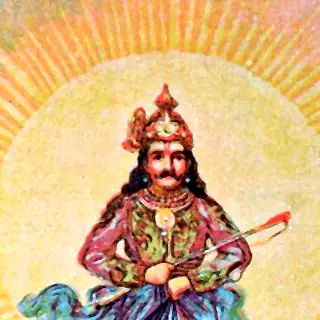
The attributes the tradition gives them — and what each one means. Not every attribute appears in the painting above; all of them live in the temples and prints.
The iron danda
Justice as a plain rod — no jewels on the instrument of consequence.
The crow
The unglamorous, intelligent survivor — his chosen companion from among the overlooked.
Deep blue-black robes
The colour of shadow, iron and the small hours — where his lessons are learned.
The slow gait, the marked limp
Shanaih-chara, 'the slow mover': consequences limp, but they arrive.
The sesame and mustard-oil lamp
His offerings are a worker's goods — the puja itself bows to honest labour.
How to learn from Shani Dev — this week
- 1
Keep Saturday as audit day: accounts squared, dues paid, one act of service to someone the week overlooked — oil in his lamp, honesty in his ledger.
- 2
Choose one 30-day 'iron vow' — a daily discipline kept without a single negotiation — and learn how his gifts are minted.
- 3
In your hardest stretch, take Vikramaditya's route: serve where you have landed, sing while the wheel turns, and write down what the bottom teaches — you will legislate from it later.
- 4
Pay everyone who works for you fully, fairly and on time — the tradition's plainest Shani-shanti, requiring no priest.
Their names, and what they mean
Shanishcharathe slow mover
Chhaya-putrason of Shadow herself
Karma-phala-datadeliverer of the fruits of action
Neelanjanaof the blue-black lustre — the Shani stotra's opening word
Panguthe limping one — even his gait teaches patience
Krura-drishti (misread), Kripa-drishti (understood)the gaze called cruel by the fearful and kind by the taught
Family & relations
Son of Surya and Chhaya; brother of Yama the lord of justice-after-death (the two offices mirror each other) and of the river Yamuna; his teacher is Shiva, whose devotion steadies his rod. The awkward distance from his blazing father — and its slow reconciliation — is itself a scripture for every strained father-son bond.
Their days
Saturday (Shanivar) bears his name — the day of oil lamps under peepal trees, iron discipline, and service to the overlooked; Shani Jayanti falls on Jyeshtha's amavasya.
Worship Shani Dev on Dharamkira
These histories are retold faithfully from named scriptures and living tradition, and regional tellings are honoured where they differ. Like all religious content on Dharamkira, they await final review before public launch.