The one god no one has to imagine — rising for every being without discrimination, driver of the seven-horse chariot, witness of all deeds, healer in light.
Surya Dev is the Sun himself — the god you can actually see every single morning! He rides a chariot pulled by seven horses (like the seven colours of light), gives energy to every plant, animal and person without asking who they are, and never, ever misses a day of work.
Why Surya is God
Every other deity asks for faith; Surya only asks that you open your eyes. He is pratyaksha devata — the god standing in plain sight — and the tradition never tired of the wonder of that: the Gayatri mantra, the most sacred verse of the Veda, is addressed to his light; the Ramayana's battle-weary Rama is taught the Aditya Hridayam before facing Ravana; and an entire classical sequence, Surya Namaskar, makes the body itself his morning hymn. He is divinity with perfect attendance — the theology of reliability.
His deeper teaching is impartiality. The Gita's favourite image for the self is borrowed from him: the sun shines on the wicked and the good, on palace and gutter, without preference and without depletion. He is karma-sakshi, witness of all deeds — nothing done under the sky escapes him — yet his response to what he sees is not punishment but continued light. Healers invoked him from Vedic times (arogya, health, is his classical gift); kings claimed his lineage (the Suryavansha of Rama); farmers still time their year by his two great turnings. To worship Surya is to practise being like him: regular, radiant, and impossible to bribe.
Origins — where the story begins
He is among the oldest continuously worshipped gods on earth. The Rig Veda hymns him by many dawns — as Surya the impeller, as Savitr the golden-handed awakener, as Pushan the nourisher on roads — and the Gayatri, humanity's longest-running prayer, has been offered to his rising for well over three millennia. The Puranas give him a family carved from his own intensity: son of Aditi and Kashyapa (hence Aditya), husband of Sanjna, who once could not bear his full blaze — so her father Vishwakarma placed the sun on his lathe and gently trimmed his rays, and from the trimmed brilliance were forged the discus of Vishnu and the trident of Shiva.
History built him houses to match: Konark's chariot-temple with its stone wheels that still tell time, Modhera's step-welled sanctum that catches the equinox sun on its deity, Martand's ruins in Kashmir. And on the rivers of Bihar and eastern UP, Chhath Puja preserves what may be the subcontinent's most ancient living liturgy — offerings to the SETTING sun first, then the rising: gratitude before request, and reverence even for departure.
Why they come
Surya's work is the most literal of all divine portfolios: he powers the world. Every meal is stored sunlight; every breath burns his fuel; the water cycle is his engine and the seasons his gait. The tradition draws the ethical consequence — a being on whom all life depends, who yet claims nothing, is the model for every provider: parents, farmers, teachers, anyone whose steady output is consumed daily without applause. His astrological office extends the same theme: in the horoscope he stands for atma-karaka concerns — the soul, the father, authority, vitality — and his remedy is always the same prescription: rise early, face the light, offer water, and become regular.
Every symbol, explained
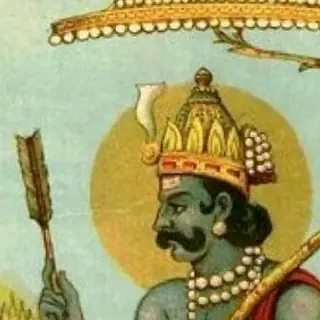
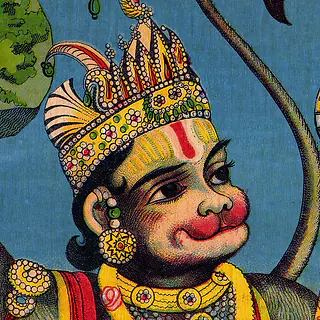
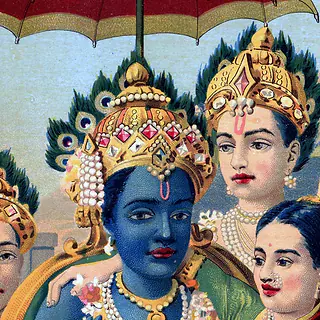
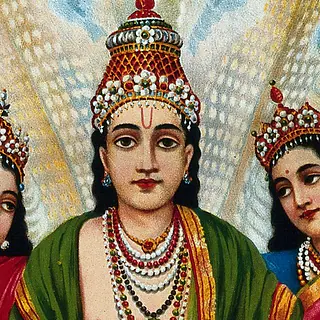
The attributes the tradition gives them — and what each one means. Not every attribute appears in the painting above; all of them live in the temples and prints.
The chariot of seven horses
The seven colours of his one light, the seven metres of the Veda — diversity harnessed to a single course.
Aruna the charioteer
Dawn himself drives — every sunrise is the god's herald seated in front.
The single wheel
The year: twelve spokes of months, six seasons for a rim, turning without pause.
Lotuses in both hands
What opens at his rising — he holds the daily proof of his own kindness.
The radiate crown
Authority that consists of giving light — the only crown made of what it gives away.
The tales of Surya
The great stories, told in full — with their sources named. Use the arrows or pick a tale.
Sanjna and the trimming of the rays
Tale 1 of 4
Sanjna, daughter of the cosmic architect Vishwakarma, married the Sun — and found that no eye, not even a devoted wife's, can rest on undimmed totality. She endured, wavered, left a shadow-double (Chhaya) in her place and fled to meditate as a mare in the northern pastures. The Sun, discovering the substitution, went to his father-in-law not in wrath but in grief: what must I change, that she can bear me?
Vishwakarma set the Sun upon his lathe and pared away an eighth of his blaze — and the trimmings did not fall as waste: from them were forged Vishnu's discus, Shiva's trident, Kartikeya's lance, the weapons that keep the cosmos. Softened, Surya sought Sanjna as a horse seeks a mare, and their reunion bore the Ashvins, healers of the gods. The tradition hands the tale to every strong personality: greatness that cannot be lived with must consent to be turned on love's lathe — and what you shave off yourself for another's sake becomes weaponry for the world's good.
Told in: Markandeya Purana; Vishnu Purana
What Surya teaches
Show up daily
His entire divinity is perfect attendance. Talent is weather; reliability is climate — build the climate.
Shine without checking who receives
The sun does not audit its beneficiaries. Do your good impartially; light that selects is already lamp-light, not sun-light.
Let love trim your blaze
Sanjna's story: intensity that scorches your nearest must accept the lathe — and the trimmed excess, given away, becomes others' weapons of good.
Honour the setting, not just the rising
Chhath's first arghya is for departure — thank people at the end of their labour, elders in their evening, endings as well as debuts.
Witness without corruption
Karma-sakshi sees everything and stays light. Practise seeing clearly — your own deeds included — without letting what you see darken what you give.
How to learn from Surya — this week
1
Give him the day's first minute: face the morning sun, offer water from a lota, and say one line of intent — the oldest habit-anchor in the tradition.
2
Adopt solar reliability for one commitment: same time daily, no negotiation, rain or mood — and watch what compounding does in ninety days.
3
Practise Surya Namaskar as worship-in-motion — the twelve names with the twelve postures; our yoga section holds the full guided sequence.
4
Once a year, keep one Chhath-spirit evening even outside the festival: watch a sunset start to finish, in thanks for everything the day's light did unthanked.
Their names, and what they mean
Adityason of Aditi, the boundless
Bhaskarmaker of light
Savitrthe awakener — the Gayatri's addressed one
Martandaborn of the lifeless egg — light that revived the void
Karma-sakshiwitness of all deeds
Arogya-datagiver of health — 'ārogyaṁ bhāskarād icchet'
Family & relations
Son of the sage Kashyapa and Aditi, eldest among the Adityas; husband of Sanjna and Chhaya; father of a mythology in himself — Yama the just, Yamuna the river, the Ashvin healers, Shani the auditor, Karna the tragic hero, and Sugriva the ally of Rama. The Suryavansha he founded runs through Ikshvaku to Rama himself.
Their days
Sunday (Ravivar) bears his name; Makar Sankranti and Ratha Saptami mark his great turnings, Chhath his deepest worship — and every sunrise is a small festival he never cancels.
These histories are retold faithfully from named scriptures and living tradition, and regional tellings are honoured where they differ. Like all religious content on Dharamkira, they await final review before public launch.