The sustainer of all worlds — resting on the cosmic serpent, awake in every age of crisis, descending again and again as the avatars so that dharma never dies.
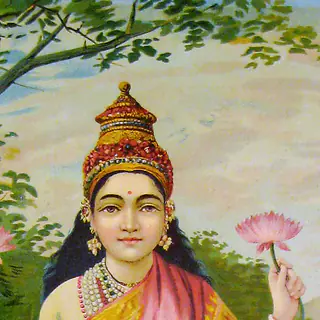
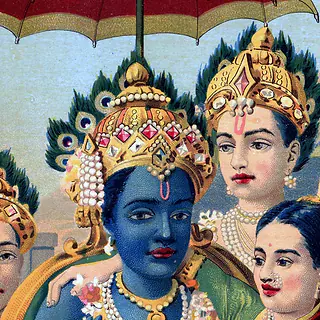
Vishnu on Shesha with his two consorts — Chromolithograph after Raja Ravi Varma, c. 1890s
✦ In the simplest words
Vishnu Bhagwan is the caretaker of the universe. He rests on a giant serpent in the milk ocean, watching over everything — and whenever bullies grow too strong and goodness is in danger, he comes down himself, as Rama, as Krishna, to set things right. His job is simple and huge: keep the world going.
Why Vishnu is God
Between the making of things and their unmaking stretches the long middle where life actually happens — and that middle is Vishnu. He is the principle that holds: orbits that stay orbits, promises that stay kept, rains that return, dharma renewed age after age. His name comes from the root 'to pervade': the Vishnu Sahasranama opens by calling him vishvam, the universe itself. The tradition pictures his maintenance not as strain but as ananta-shayana — reclining at total ease on the serpent Endless, because the deepest power holds everything without gripping anything.
His signature idea is the avatar — the promise, spoken in the Gita's own metre, that whenever dharma declines 'I send myself forth, age after age.' The fish that saves the seed of life, the tortoise that steadies the churning, the boar that lifts the drowned earth, the man-lion that answers a child's faith, the dwarf who measures the cosmos, and then Parashurama, Rama, Krishna — the Dashavatara reads as creation's biography with Vishnu arriving at every crisis in exactly the form the crisis requires. Preservation, his devotees learn, is not passivity: it is love willing to descend.
Origins — where the story begins
In the Rig Veda he is already present as the strider — the god whose three steps span earth, air and heaven, with the highest step called his supreme abode. The Upanishadic and epic ages watched that third step widen until it held everything: as Narayana, 'he who rests on the waters', he becomes the ground of the cosmos itself. The Shatapatha Brahmana and the epics tell the merger frankly — Vedic Vishnu of the three steps and cosmic Narayana of the primeval sea recognised as one Lord.
The Puranic canvas then paints the images the tradition lives with: Vishnu dark as the rain-cloud, four-armed with shankha, chakra, gada and padma; Lakshmi at his feet; Brahma rising from his navel-lotus to begin each cosmic day; the sages debating — and the Bhagavata resolving — that of Brahma, Vishnu and Shiva, sattva's own face is his. Vaishnava traditions from the Alvars of the Tamil south to Chaitanya's Bengal built on one experiential claim: the sustainer of the universe is approachable — as friend, as child, as beloved — because pervading everything, he was never far.
Why they come
Vishnu's work is continuance. Creation is an event; destruction is an event; but keeping a universe running — adjusting, repairing, feeding, defending — is a vigil without end, and that vigil is his worship-name Hari, 'the remover' of what obstructs life. His method has two speeds. In the ordinary hour he sustains invisibly: sun rising, rain returning, dharma transmitted. In the extraordinary hour he descends — always at the point of the system's despair, always in a form the crisis itself has made necessary, and always to reset, not merely to rescue: each avatar leaves behind a renewed template of how to live. The Gita is that template written down.
Every symbol, explained
The attributes the tradition gives them — and what each one means. Not every attribute appears in the painting above; all of them live in the temples and prints.
The shankha (Panchajanya)
The primal sound Om blown into the world — every puja's conch echoes his.
The chakra (Sudarshana)
'The good-seeing' discus: time and truth spinning too fast for adharma to outrun.
The gada (Kaumodaki)
Strength held in reserve — authority that protects, rarely strikes.
The padma
The world flowering from him — creation offered back as beauty.
Ananta-Shesha, the serpent couch
Infinity itself made restful — endlessness serving as the bed of stability.
Shrivatsa and Kaustubha on the chest
Lakshmi's mark and the ocean's jewel worn at the heart: prosperity lives where dharma lives.
The tales of Vishnu
The great stories, told in full — with their sources named. Use the arrows or pick a tale.
Three steps — the dwarf who measured everything
Tale 1 of 4
The demon king Mahabali had become that rarest problem: a tyrant by generosity — righteous, beloved, and swallowing the three worlds through sheer merit. Force would have been unjust; the universe's balance needed a subtler instrument. Vishnu came as Vamana, a dwarf student with an umbrella, and asked the emperor of everything for three steps of land. Bali's guru Shukracharya saw through the boy; Bali, to his eternal credit, chose the dignity of giving over the safety of suspicion.
The dwarf grew. One step covered the earth; the second, the heavens; and for the third, with nothing left in the cosmos, Bali offered his own head. Vishnu's foot pressed him down to rule the netherworld — and the 'defeat' became the tradition's strangest honour: Vishnu himself stands guard at Bali's door, and the king returns to his people once a year, a visit Kerala keeps as Onam. Generosity, the tale rules, may cost you three worlds and still win you God as your gatekeeper.
He sustains galaxies reclining. Responsibility carried with clenched fists breaks the carrier; the deepest holding is relaxed, rhythmic, renewable.
Descend for what you love
The avatar principle in one line: love that stays upstairs is spectatorship. When your family, team or dharma falters — come down, in the form the crisis needs.
Be the tortoise sometimes
Someone must be the unseen base of every churning. Take turns being foundation — unthanked, essential — and honour whoever is holding yours.
Keep promises like orbits
Preservation is made of kept words: rains, seasons, dharma — and your own commitments. Reliability is a form of worship of Vishnu.
Answer real cries first
Gajendra's lotus outranked a thousand rituals. Keep your accessibility for genuine helplessness — and when you are helpless, call; polish is not required.
How to learn from Vishnu — this week
1
Adopt one 'sustainer duty' and keep it with orbital reliability — a plant, a ledger, a person you check on every week without being asked.
2
On Ekadashi, practise his lightness: simpler food, more remembrance — the fortnightly tune-up his devotees have kept for millennia.
3
When conflict rises, reach for Vamana's method before the gada: smallness, wit and asking rightly can win what force would ruin.
4
End each day with three steps of your own: one for the body (rest), one for the people (a kindness closed), one for the beyond (a verse of the Gita).
Their names, and what they mean
Narayanahe whose resting place is the waters — refuge of all beings
Harithe remover — of sorrow, sin and obstruction
Trivikramaof the three great strides
Ananta-shayanahe who reclines on the endless serpent
Jagannathalord of the world — Puri's own beloved form
Achyutathe unfallen — he who never fails those who hold him
Family & relations
Eternal consort of Lakshmi; from his navel-lotus rises Brahma; Garuda bears him and Shesha bears his rest. Through the avatars his family is history itself — Rama's Ayodhya, Krishna's Braj and Dwarka — and through Prahlada, Dhruva, Gajendra and the Alvars, an unbroken lineage of those who called and were answered.
Their days
Thursday (Guruvar) is his and his teachers' day; every Ekadashi is his fast, and the four months of Chaturmas his cosmic night — opened and closed by the two great Ekadashis.
These histories are retold faithfully from named scriptures and living tradition, and regional tellings are honoured where they differ. Like all religious content on Dharamkira, they await final review before public launch.