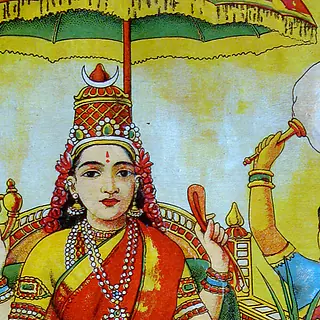
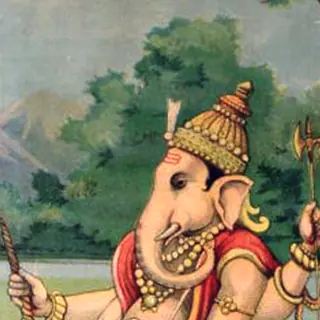
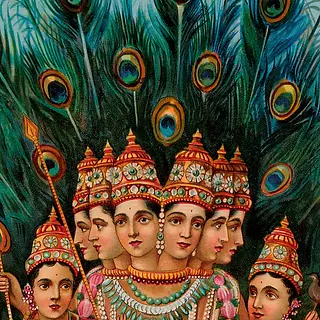
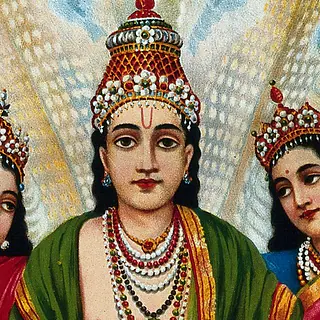
The great god of stillness and storm — ascetic on the mountain, householder with Parvati, drinker of the world's poison, and the consciousness in which everything dances.
Shiva in contemplation — Popular colour lithograph, Calcutta (British Museum album), c. 1895
✦ In the simplest words
Shiva is the god who sits very, very still on a snowy mountain — so still that his heart holds the whole universe. He's the easiest god to make happy (a little water on his Shivling is enough!), and when something poisonous threatens everyone, he's the one who swallows it to keep the world safe.
Why Shiva is God
Shiva is what remains when everything else is subtracted — the tradition's name for pure consciousness itself. Brahma makes, Vishnu maintains, Shiva dissolves; but his dissolution is not destruction for its own sake. It is the clearing of the canvas without which nothing new can be painted, the exhale without which no inhale comes, the silence between thoughts in which meditators actually meet him. That is why yogis call him Adiyogi, the first of their line, and why his deepest image is not a warrior but a man sitting absolutely still.
Yet no god holds opposites the way Shiva does. The perfect ascetic is also the perfect husband; the destroyer wears a crescent moon like an ornament of tenderness; the terrifying Mahakala, time itself, melts for a child's offering of water. His name means 'the auspicious one', and his most loved name, Bholenath, means the innocently generous lord — the god who grants too easily, whom demons routinely exploit and devotees routinely adore, because he simply cannot hear a sincere call and stay unmoved.
Origins — where the story begins
Ask the texts where Shiva comes from and they answer with a story about the question itself. In the Shiva Purana's Lingodbhava account, Brahma and Vishnu were disputing which of them was supreme when an endless pillar of light split the cosmos between them. Vishnu dove for ten thousand years and found no base; Brahma flew and found no summit (and famously lied about it). The pillar was Shiva — anadi, without beginning — and the linga worshipped in every Shiva temple is that infinity made small enough for a palmful of water.
History's memory runs almost as deep as myth's. In the Rig Veda he is Rudra, the howling storm-archer whose arrows are feared and whose healing is begged; the Shvetashvatara Upanishad unveils Rudra as the one God; the Yajurveda's Shri Rudram — still chanted over abhishekams today — bridges the fierce archer and the auspicious Shiva. By the epics and Puranas the mountain ascetic, the Nataraja of Chidambaram, and Kashi's beloved Vishwanath are all recognisably one lord: the Vedas' storm, grown vast enough to hold silence.
Why they come
Shiva's cosmic office is the ending that makes continuing possible. Without dissolution the universe would choke on its own accumulations — old forms, old karmas, old selves. So he burns Kama when desire disturbs tapasya, drinks halahala when the churn of progress produces poison, wears cremation ash to certify that endings are not unclean, and dances the tandava in which each footfall closes one age and opens another. For the individual soul his work is identical at smaller scale: he is the force that ends what you have outgrown — which is why his devotees, from Markandeya onward, discover that the destroyer is the one god death itself obeys.
Every symbol, explained
The attributes the tradition gives them — and what each one means. Not every attribute appears in the painting above; all of them live in the temples and prints.
The trishul
One shaft, three points: the three gunas, the three times, the three worlds — held in a single steady hand.
The damaru
The two-headed drum whose beat, tradition says, released the sounds from which language and the cosmos rhythm arise.
The crescent moon
The waxing-waning mind worn as an ornament — time and moods mastered, not suppressed.
The third eye
The inward eye of direct seeing — its one recorded opening burned desire itself to ash.
The naga around the throat
Fear itself, worn as jewellery — what terrifies others rests tame on him.
Ganga in the jata
A river that would have shattered the earth, caught and gentled in his hair — grace made survivable.
The tales of Shiva
The great stories, told in full — with their sources named. Use the arrows or pick a tale.
Neelkanth — drinking the poison
Tale 1 of 5
When devas and asuras churned the ocean for amrita, the sea yielded its treasures in order — and then, before the nectar, the halahala: a poison so total that it began cooking the three worlds at once. The churners who wanted immortality scattered; the poison belonged to everyone and no one would take it.
Shiva, who had churned for nothing and asked for nothing, cupped the world's death in his palms and drank. Parvati pressed his throat to hold the poison there — neither out, to burn creation, nor down, to touch the self within. It rests there still, a blue collar on the fairest throat, renewing his name Neelkanth. The tradition reads it plainly: greatness is measured by which poisons you agree to hold so others can keep churning for nectar.
Told in: Samudra manthan, Bhagavata & Vishnu Purana
What Shiva teaches
Hold the poison, share the nectar
In every family and team, something toxic surfaces. The Shiva-move is to absorb it at the throat — acknowledged, contained, never swallowed into the heart, never sprayed onto others.
Be easy to please
A god satisfied by plain water shames our inflated requirements. Accept simple offerings — from others and from life.
Endings are holy work
Old habits, finished chapters, outgrown selves — closing them well is Shiva's own duty performed in miniature. Ash is not failure; it is the canvas cleared.
Stillness is strength's source
The wildest tandava comes from the deepest meditation. Build a still centre first; motion drawn from stillness does not wobble.
Wear your fears as ornaments
The serpent stays on his throat, not in a cage. Faced and befriended, what frightens you becomes part of your presence.
How to learn from Shiva — this week
1
Keep one daily pocket of complete stillness — even three minutes of kaya sthairyam or 'Om Namah Shivaya' — and guard it like Kailash.
2
When a group's churn produces poison — blame, panic, gossip — volunteer your throat: absorb without passing it on, and don't let it reach your heart either.
3
Practise Monday simplicity: one weekly act of deliberate less — simpler food, fewer words, a fast if health allows — as your standing appointment with Bholenath.
4
Close finished things formally — a completed notebook, an ended project, a grief ready to be released — with thanks and a clean ending, the way aarti closes a puja.
Their names, and what they mean
Mahadevathe great god — the gods' own god
Bholenaththe innocently generous lord, quickest to bless
Neelkanththe blue-throated holder of the world's poison
Natarajaking of the dance in which worlds end and begin
Mahakalatime beyond time, before whom death withdraws
Ashutoshpleased in an instant
Family & relations
Husband of Parvati (and of Sati in her former birth); father of Ganesha and Kartikeya; his household on Kailash — with Nandi the bull at the door and the ganas all around — is the tradition's picture of wildness and domesticity at peace with each other.
Their days
Monday (Somvar) — the moon's day for the moon-crowned lord; Pradosh evenings, the monthly Shivratri, and the whole month of Sawan deepen the same devotion.
These histories are retold faithfully from named scriptures and living tradition, and regional tellings are honoured where they differ. Like all religious content on Dharamkira, they await final review before public launch.