
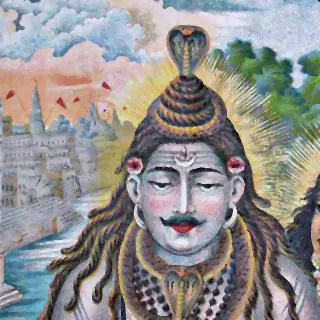
Shiva
Mahamrityunjaya mantra
ॐ त्र्यम्बकं यजामहे सुगन्धिं पुष्टिवर्धनम् । उर्वारुकमिव बन्धनान्मृत्योर्मुक्षीय मामृतात् ॥
Simple reading
Om tra-yam-ba-kam ya-jaa-ma-he, su-gan-dhim push-ti var-dha-nam, ur-vaa-ru-kam i-va ban-dha-naan, mrit-yor muk-shee-ya maam-ri-taat
Oṁ tryambakaṁ yajāmahe sugandhiṁ puṣṭi-vardhanam, urvārukam iva bandhanān mṛtyor mukṣīya māmṛtāt
About this mantra
The great death-conquering mantra of Shiva as Tryambaka, the three-eyed one; chanted for healing, protection, and fearlessness in difficult times.
Meaning
We worship the three-eyed one, fragrant, nourisher of all. As the ripe cucumber is released from its vine, may I be freed from death, not from immortality. The image carries the whole teaching: the fruit does not tear itself from the vine; it ripens until release is effortless. So the prayer is not to escape dying. It is to be so fully ripened that death loses its grip, while the bond with the deathless is never cut.
Learn it by heart
Say the first line until it comes without reading, then add the next line and say both, until the whole mantra comes on its own.
Line 1 of 2
ॐ त्र्यम्बकं यजामहे सुगन्धिं पुष्टिवर्धनम् ।
Oṁ tryambakaṁ yajāmahe sugandhiṁ puṣṭi-vardhanam, urvārukam iva bandhanān mṛtyor mukṣīya māmṛtāt
0not said yet
Aim for eleven before the next line. Move on when the line comes without reading.
Progress stays on this device.
When to recite it
The mantra of hard passages: illness in the family, the morning of a surgery, long recovery, fear of death, and memorial days. Counted 108 times, often at dawn, and through Sawan and Shivratri. Many recite it on another's behalf, holding their name inwardly.
Word by word
- त्र्यम्बकंtryambakaṁ
- the three-eyed one (Shiva)
- यजामहेyajāmahe
- we worship, we honour
- सुगन्धिंsugandhiṁ
- fragrant, of sweet presence
- पुष्टिवर्धनम्puṣṭi-vardhanam
- who nourishes and makes flourish
- उर्वारुकमिवurvārukam iva
- like the ripe cucumber (from the vine)
- बन्धनात्bandhanāt
- from bondage
- मृत्योःmṛtyoḥ
- from death
- मुक्षीयmukṣīya
- may I be freed
- मामृतात्mā amṛtāt
- but not from immortality
Source: Ṛgveda 7.59.12