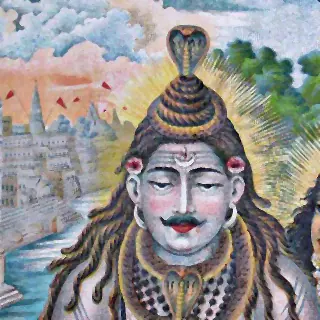
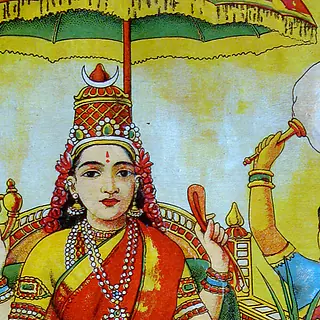
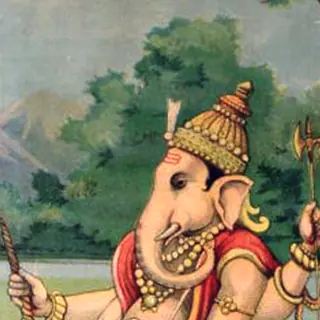
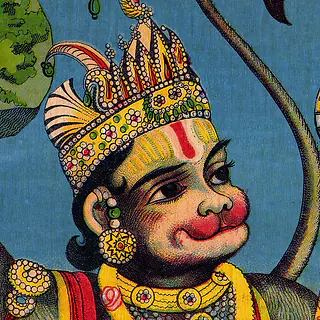
The six-faced son of Shiva, born to end a tyranny no one else could — general of the gods, lord of the vel, and the Tamil lands' most beloved god of youth and courage.
Murugan (Kartikeya) with his consorts — Raja Ravi Varma / Ravi Varma Press, c. 1900s
✦ In the simplest words
Kartikeya — called Murugan in the south — is the gods' young general. Born from Shiva's spark and raised by six star-mothers, he has six faces to see in every direction and a glowing spear called the vel. He defeated the demon nobody could defeat when he was just a boy — proof that being young doesn't mean being small.
Why Kartikeya is God
Kartikeya is divine energy at the age of courage. The tradition needed a god who is forever young without being unripe — commander of heaven's armies at six days old, teacher of the meaning of Om to his own father, and yet the perpetual boy of the hills whom Tamil devotion simply calls Murugan, 'the beautiful one'. He is what Shiva's stillness looks like when it stands up to act: tapas become tejas, the meditation of Kailash forged into a spear.
His weapon explains his path. The vel — given by his mother Parvati — is knowledge concentrated to a point: broad at the base like study, long like practice, and sharp at the tip like the single insight that ends a demon. The Skanda tradition and the Tamil siddhas read every battle inward: Surapadman's shape-shifting is the ego's disguises, the vel is discrimination, and the enemy is never destroyed but transformed — into the peacock he rides and the rooster on his flag. Even his wars end in conversion, not corpses.
Origins — where the story begins
His birth is the tradition's most intricate relay of grace. Taraka's tyranny could end only by a son of Shiva — who was sealed in grief-meditation. After Parvati's tapasya re-opened the world's heart, a spark of Shiva's incandescence proved too fierce for any single womb: Agni carried it and burned; Ganga cooled and carried it and could not hold it; the river laid it in a forest of sharas reeds. There six Krittika stars found six babies — or one baby of six faces — and nursed him as six mothers. When Parvati gathered him he became one child with six faces: Shanmukha, fathered by fire, mothered by a goddess, a river and the Pleiades together.
History then did something remarkable: the northern Skanda of the epics found his eternal home in the Tamil south, where he merged with Murugan, the ancient hill-god of beauty and war already sung in Sangam poetry two thousand years ago. Six great abodes — the Arupadai Veedu — map his life onto Tamil soil; Palani's hill, Tiruchendur's shore. The result is one of Hinduism's deepest fusions: Sanskrit Purana and Tamil devotion holding one god between them, argued over lovingly, and worshipped by millions with the kavadi on their shoulders.
Why they come
He was born with a job description: end Taraka, whom no existing being could touch. That specificity is his teaching — some knots require not more force from the old players but a new birth: fresh energy, unburdened by the compromises that let the problem grow. As Devasenapati, commander of the gods' army, his standing office is the ordering of strength: courage given strategy, youth given direction. And in his Tamil heart he keeps a second office — god of the steep path. Every hill shrine climbed step by step, every kavadi carried, rehearses his answer to burdens: shape them, decorate them, carry them dancing to the top.
Every symbol, explained
The attributes the tradition gives them — and what each one means. Not every attribute appears in the painting above; all of them live in the temples and prints.
The vel (spear)
Parvati's gift: wisdom broad in study, long in practice, needle-sharp in insight.
Six faces
All directions and the within watched at once; six mothers answered with one face each.
The peacock mount
The defeated demon transformed and serving — vanity mastered into beauty that carries you.
The rooster banner
The other half of the demon, crowing the dawn — even the ego's remainder can announce the light.
The kavadi
Devotees' decorated burden: sorrow shaped into an offering and danced up the hill.
The tales of Kartikeya
The great stories, told in full — with their sources named. Use the arrows or pick a tale.
Six days old, commander-in-chief
Tale 1 of 4
Taraka's boon had been drafted with an ascetic's cunning: death only by a son of Shiva — who had none, and whose grief promised none forever. Armoured in that impossibility the demon farmed the three worlds, and Indra's armies broke against him age after age. When the impossible son finally lay in the reeds, the gods did not wait for him to grow up; the crisis conscripted the infant, and the infant accepted.
The Purana enjoys the arithmetic: six days from birth, Skanda was consecrated Devasenapati — heaven's armies in the hands of a child the stars were still nursing. The war that followed shook the seas; Taraka fell to the vel; and the tradition drew its double lesson. For tyrants: your safety-clause is always growing up somewhere. For the young: capability is not a birthday — when dharma appoints you, six days is seniority enough.
Six days old, commander-in-chief. When dharma calls you to responsibility, your age — young or old — is not the disqualifier fear claims it is.
Sharpen to a point
The vel's geometry is a study plan: broad foundations, long practice, and one honed point of mastery that can end your Taraka.
Convert, don't just conquer
His defeated demon became his peacock. The parts of yourself you defeat — anger, vanity, restlessness — should end up carrying you, not buried in you.
Carry your burden beautifully
The kavadi is grief given craftsmanship. Burdens you cannot drop can still be shaped, decorated and danced uphill.
Let truth outrank the chair
Shiva sat below his son to learn. In any room, the correct answer holds seniority — and honouring that, whoever speaks it, is strength.
How to learn from Kartikeya — this week
1
Define your Taraka precisely — the one problem your current habits cannot kill — and give it a newborn approach: fresh method, fresh schedule, no legacy compromises.
2
Build a vel: pick one skill this year for broad-base study, daily practice length, and one competition-grade point of sharpness.
3
Practise Skanda Sashti's six-day rhythm in miniature: six days of focused discipline against one inner demon, ending with its 'conversion' — assign the reformed habit a job.
4
When passed over — a prize, a role, a fruit — take the Palani route consciously: withdraw with dignity, climb your hill, and turn the hurt into a place others can heal at.
Their names, and what they mean
Muruganthe beautiful one — Tamil devotion's own name
Skandathe leaper, the attacker — energy that pounces
Shanmukhasix-faced
Subrahmanyadear to the wise — friend of the luminous
Devasenapaticommander of the gods' army (and lord of Devasena)
Vela-yudhawhose weapon is the vel
Family & relations
Son of Shiva and Parvati — with Agni, Ganga and the six Krittikas honoured as mothers of his passage; brother of Ganesha, their contests the tradition's warmest sibling scripture. In the south he weds Devasena (Indra's daughter, order) and Valli (the hill-tribe huntress, wild devotion) — heaven and earth both married into one house.
Their days
Tuesday is his day in the south's reckoning; every month's Sashti (sixth tithi) is his, Skanda Sashti's six days his great war-festival, and Thaipusam his vel-bright pilgrimage.
These histories are retold faithfully from named scriptures and living tradition, and regional tellings are honoured where they differ. Like all religious content on Dharamkira, they await final review before public launch.