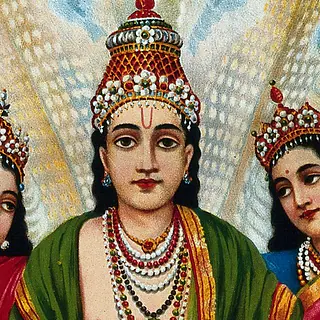
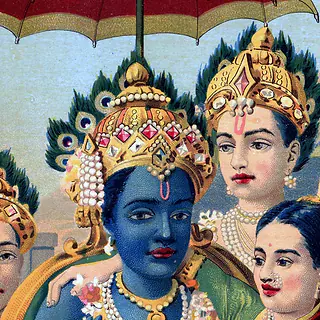
The butter-thief of Gokul, the flute of Vrindavan, the charioteer of Kurukshetra — God playing every role of a human life to perfection, and teaching the Gita from the middle of its hardest scene.
Krishna playing the flute to Radha — Unknown press, chromolithograph, 1897
✦ In the simplest words
Krishna is the god who shows that God can be your friend. As a baby he stole butter and giggled; as a boy he played the flute so sweetly the cows stopped grazing; as a friend he drove Arjuna's chariot and taught him the Bhagavad Gita — how to be brave, do your duty and not be afraid. Blue like the sky, always smiling, always on your side.
Why Krishna is God
The tradition calls him purna-avatara — the complete descent — because no register of existence is missing from his life: infant mischief and metaphysics, romance and war, village and empire, dance and death. Where Rama teaches by walking one straight line perfectly, Krishna teaches by playing every curve of life without being owned by any — the master-word of his path is lila, divine play. His flute states the theology without a syllable: God is not summoning the world to judgment; he is calling it to a dance.
And yet the playful god delivered the tradition's most serious sentence. On a battlefield, to a warrior in collapse, Krishna spoke the Bhagavad Gita — seven hundred verses that turned crisis into curriculum: act without clutching outcomes; your right is to the work alone; offer everything, fear nothing, come to me. He is simultaneously the tradition's sweetest intimacy — Yashoda's thief, the gopis' beloved, Sudama's friend — and its steeliest clarity. Butter in one hand, the wheel of dharma in the other: that is Krishna, and neither hand ever drops its hold.
Origins — where the story begins
He was born a prisoner. Kamsa of Mathura, warned by a sky-voice that his sister Devaki's eighth child would end him, chained the parents and killed six newborns. The seventh, Balarama, was transferred by divine device; the eighth arrived at midnight on the dark eighth of Bhadrapada (Shravana by the amanta count of the south and west) — and the prison answered him: fetters opened, guards slept, doors swung wide. Vasudeva carried the infant through a storming Yamuna, the serpent Shesha spreading hood as umbrella, and exchanged him for a cowherd's newborn daughter in Gokul. She, seized by Kamsa, rose from his hands as the goddess Yogamaya and laughed: your death already lives.
The Bhagavata Purana — his scripture of scriptures — then follows the hidden god through a cowherd childhood the tradition has never stopped retelling: poison-nursed Putana, the cart and whirlwind demons, butter raids organised with military precision, and the afternoon Yashoda looked into her son's yawning mouth and saw the universes. Mathura's tyrant fell while he was still a boy — the texts do not agree on the year; Dwarka rose in the west; Kurukshetra waited in the north — but Braj holds his heart, and holds it still.
Why they come
Krishna descended, by his own Gita declaration, to rescue dharma in an age too tangled for straight lines. Rama's era permitted perfect rules; Krishna's demanded perfect judgment — tyrants holding legal thrones, wars where every option wounded someone innocent. His work was to demonstrate discernment: when to charm and when to break, when to lift a mountain over the innocent and when to counsel a terrible war, and how to act in all of it untouched — the lotus-leaf on water he made the Gita's emblem. His second purpose was sweeter and vaster: to throw devotion open. After Krishna, the tradition's door is the heart — a flute-note, a name, a handful of rice from a poor friend outweighing empires of ritual.
Every symbol, explained
The attributes the tradition gives them — and what each one means. Not every attribute appears in the painting above; all of them live in the temples and prints.
The bansuri
An empty reed become infinite music: the soul hollowed of ego is what God plays through.
The morpankh (peacock feather)
Beauty worn weightlessly — a crown that costs no one anything.
The cloud-blue skin
The colour of sky and deep water: what is infinite looks blue from where we stand.
Butter in a child's fist
The heart's cream — he steals only what is soft in you, and only to enjoy it with you.
Govardhan on the little finger
Immense protection, casually held — and he asked the villagers to keep their own staffs touching the hill.
The chariot reins at Kurukshetra
God taking the driver's seat, not the warrior's: guidance, not replacement, is his promised role.
The tales of Krishna
The great stories, told in full — with their sources named. Use the arrows or pick a tale.
The universe in a yawn
Tale 1 of 4
The playmates reported the toddler had eaten mud. Yashoda, a mother before all metaphysics, caught her son and commanded: open your mouth. He opened it — and she saw no mud but the wheeling galaxies, oceans, mountains, time in all directions, Gokul itself, and one small woman inside it peering into the mouth of her child, inside whose mouth wheeled the galaxies again.
For a heartbeat she stood at the edge of the knowledge that annihilates motherhood — then Krishna, choosing her love over his own revelation, drew maya's veil, and she remembered only that her boy was sweet and possibly hungry. The Bhagavata leaves both truths standing: the universe fits in his mouth, and he prefers to be spoon-fed by his mother. Bhakti tradition calls this its central secret — God hides his infinity so that love, not awe, can be the relationship.
Told in: Bhagavata Purana, tenth canto
What Krishna teaches
Act; release the fruit
The Gita's axis: your jurisdiction is effort, not outcome. Work owned, results offered — anxiety has nowhere left to live.
Be the flute
Hollow of ego, the reed makes music it could never compose. Empty yourself of self-importance and larger intelligence plays through.
Worship the near mountain
Govardhan's question stands: honour what actually sustains you — parents, soil, teachers, teammates — before distant thrones.
Guide; don't grab the bow
He drove the chariot and let Arjuna fight. For parents, mentors, leaders: counsel completely, then let them act — replacement is not love.
Read the love inside the gift
One fistful of rice moved him more than tribute from kings. Measure what people bring you by their heart's percentage, not the market's.
How to learn from Krishna — this week
1
Before every major effort, set the Gita contract in one line — 'my work: full; the fruit: offered' — write it on the exam pad, the pitch deck, the case file.
2
Keep a Sudama drawer: accept and treasure the small offerings people make you — notes, sweets, time — with visible delight; reciprocate beyond keeping score.
3
Practise lila: bring play into one duty daily — sing while cleaning, make the revision a game — Krishna's rule that joy and seriousness are teammates.
4
When a friend collapses mid-battle — exams, grief, failure — take the charioteer's seat: presence first, clarity second, their bow back in their hands last.
Their names, and what they mean
Govindafinder and protector of the cows — herdsman of all souls
Madhavalord of Lakshmi — sweetness with sovereignty
Murlidharbearer of the flute
ParthasarathiArjuna's charioteer — God in the service seat
Makhan-chorthe butter thief — divinity you can scold
Jagadguruteacher of the world — the Gita's voice
Family & relations
Son of Devaki and Vasudeva; raised by Yashoda and Nanda — two mothers, both true. Brother of Balarama and Subhadra; beloved of Radha and the gopis in Braj's theology of love; husband of Rukmini and Satyabhama in Dwarka; friend of Arjuna, Draupadi and Sudama — the god whose family tree is drawn entirely in relationships of the heart.
Their days
Janmashtami's midnight is his hour of hours; Wednesdays and Thursdays lean to him regionally, Govardhan Puja and Gita Jayanti carry his autumn and winter — and every flute note anywhere is, briefly, his day.
These histories are retold faithfully from named scriptures and living tradition, and regional tellings are honoured where they differ. Like all religious content on Dharamkira, they await final review before public launch.