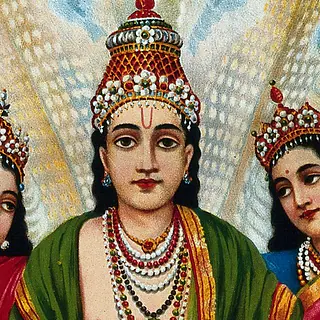
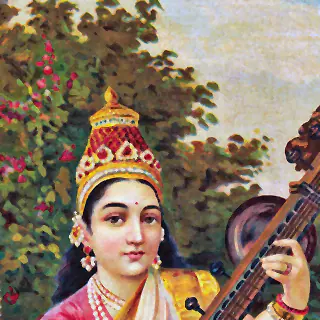
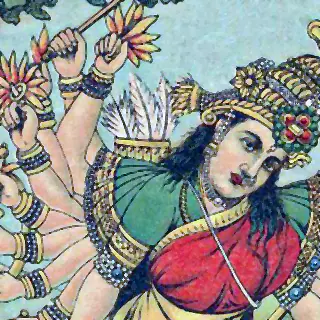
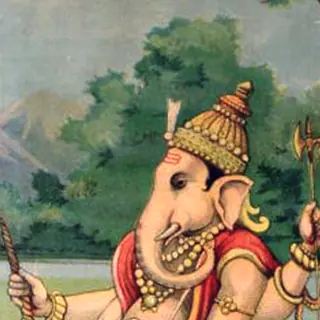
Lakshmi — Raja Ravi Varma, c. 1896 (Ravi Varma Press print)
✦ In the simplest words
Lakshmi Ma is the golden goddess of everything flourishing — money, yes, but also good harvests, happy homes, kindness and beauty. She sits on a lotus and visits homes that are clean, honest and full of light — that's why everyone cleans up and lights diyas on Diwali!
Why Lakshmi is God
Before she is the goddess of money she is Shri — a Vedic word the tradition never fully translates because it means everything at once: radiance, auspiciousness, dignity, the glow on things that are thriving. The Shri Sukta of the Rig Veda already hymns her as golden, garlanded, moist with life. Wealth is only Shri's most countable symptom; a fed child, a lit courtyard, a business run honestly, a face at peace — the tradition files all of it under Lakshmi. Her lotus states the law: rooted in mud, flowering above water — prosperity that rises through the world's mess without smelling of it.
Her worship carries a built-in ethics the tradition never lets devotees forget. She is Chanchala, the restless one: she stays nowhere ill-gotten, nowhere arrogant, nowhere unclean, nowhere quarrelsome. She follows dharma the way rivers follow gravity — the texts pair her permanently with Vishnu because sustenance without order curdles. And once a year, on Sharad Purnima and Diwali night, she walks the dark asking a single question — 'who is awake?' — the tradition's reminder that abundance visits the alert.
Origins — where the story begins
Her most famous arrival is from the ocean of milk. As devas and asuras churned for amrita, the sea gave up its wonders one by one — and then, luminous beyond all of them, Lakshmi rose seated on a full-blown lotus, the waters garlanding her, the elephants of the directions bathing her in golden streams: the scene every 'Gajalakshmi' image keeps. She surveyed both armies of churners — and placed her garland around Vishnu's neck. The choice is the theology: abundance emerges from effort (the churning), but it stays only with the preserver of order.
The Vedic layer runs earlier still: the Shri Sukta invokes her with fire's own mantras, asking not for luck but for Shri that endures — cattle, gold, grain, longevity, and the driving away of her dark sister Alakshmi, misfortune. The Puranas add her constancy: in every avatar of Vishnu she descends alongside — Sita with Rama, Rukmini with Krishna — prosperity refusing to be separated from dharma in any age.
Why they come
Lakshmi's cosmic office is sustenance made gracious. Creation can exist and still starve; be maintained and still be joyless. She is the difference — the sap in the harvest, the profit in honest trade, the beauty that makes a house a home. Her partnership with Vishnu divides the work of preservation: he upholds the cosmic order, she pours through it the nourishment that makes order worth upholding. And her restlessness is itself her instrument: by leaving wherever adharma, filth or arrogance settle, she disciplines the world toward the conditions of flourishing — a goddess who teaches economics by her exits.
Every symbol, explained
The attributes the tradition gives them — and what each one means. Not every attribute appears in the painting above; all of them live in the temples and prints.
The lotus seat
Purity that grows through mud — wealth's only honourable route.
Gold coins streaming from her palm
Abundance that flows outward — held wealth stagnates, given wealth circulates as Shri.
The two elephants (Gajalakshmi)
Royal power and rain-clouds both — sovereignty and monsoon bathing prosperity into the fields.
Red sari, gold border
Life's active energy hemmed with permanence — festivity that endures.
The owl (Ulooka) beside her in Bengal's telling
Wealth's warning: riches without vision see in the dark only — Lakshmi must be paired with wisdom.
The kalash of plenty
The brimming pot every Varalakshmi altar dresses as her body: fullness as a household guest.
The tales of Lakshmi
The great stories, told in full — with their sources named. Use the arrows or pick a tale.
Rising from the ocean of milk
Tale 1 of 4
The churning of the ocean is the tradition's parable of every great enterprise: gods and demons pulling the same serpent-rope, a mountain for a churn-stick, and long labour before any nectar. The sea tested the churners first — poison, which only Shiva could take — and then began releasing treasures: the wish-cow, the moon, the seven-headed horse. And then the water lit up from below.
Lakshmi rose on her lotus, and the cosmos paused its war economy to receive her: the directions' elephants poured golden abhisheka, sages chanted the Shri Sukta, and both armies proposed. She passed over the powerful, the clever and the loud, and garlanded Vishnu, who had asked nothing and steadied everything — the churn's axis had been his tortoise back. The tale prices its own moral: fortune emerges from shared labour, weds itself to quiet steadiness, and was never, at any point, the loudest bidder's to claim.
Told in: Vishnu Purana; Bhagavata Purana
What Lakshmi teaches
Clean first, then pray
Diwali's order of operations is the theology: the scrubbed house is the real invitation. Order your space, accounts and speech — then light the lamp.
Wealth is a guest, not a captive
Chanchala stays where she is honoured and leaves where she is hoarded against dharma. Circulate: give, pay fairly, share the harvest.
Stay awake
Kojagari's whole examination has one question. Alertness — to opportunity, to people, to your own accounts — is the posture prosperity can find.
Pair her with the owl's warning
Wealth without vision sees only in the dark. Keep Saraswati's lamp beside Lakshmi's coins — the tradition worships them together for exactly this reason.
Honour what you have received
Indra lost heaven's Shri in one careless minute. Gratitude is not etiquette; it is maintenance.
How to learn from Lakshmi — this week
1
Keep Friday as Shri-discipline: accounts honest and current, one corner of the home deep-cleaned, one lamp at dusk with 'Om Shreem Mahalakshmyai Namah'.
2
Practise circulation: from everything earned, a fixed share flows out — family, giving, fair dues — before anything is hoarded.
3
Guard mealtimes from quarrels — the folk rule that Lakshmi leaves tables where food is eaten in anger is household psychology of the first order.
4
Once a year keep one full Kojagari vigil — moon, kheer, family games, no screens — and audit what you have been too asleep to notice.
Their names, and what they mean
Shriradiant auspiciousness — the word prefixed to every honoured name
Kamalashe of the lotus
Chanchalathe restless one — wealth that must be honoured to stay
Gajalakshmibathed by the elephants of rain and royalty
Dhana-Dhanya Lakshmiwealth of coin and of grain — the eight-fold Ashtalakshmi's twin pillars
Bhagyalakshmifortune herself, invoked at every new beginning
Family & relations
Eternal consort of Vishnu, descending with him in every age — as Sita beside Rama, as Rukmini beside Krishna. Daughter of the ocean in the churning account, and of the sage Bhrigu in an earlier telling (hence Bhargavi). Worshipped on Diwali beside Ganesha — wisdom and wealth deliberately seated together.
Their days
Friday (Shukravar) is her weekly day; Diwali's amavasya is her great night, Sharad Purnima her moonlit walk, and Varalakshmi Vratam the south's own Friday of fridays.
These histories are retold faithfully from named scriptures and living tradition, and regional tellings are honoured where they differ. Like all religious content on Dharamkira, they await final review before public launch.