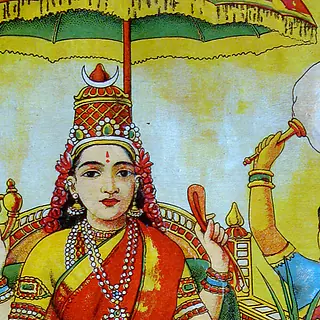
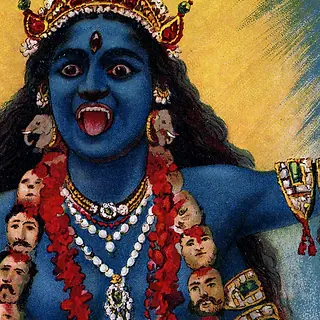
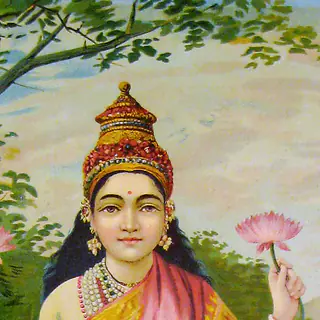
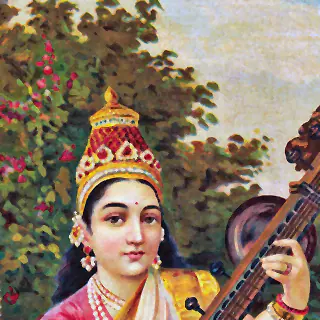
The Goddess as the universe's answer to tyranny — born of all the gods' light united, riding the lion, ten arms carrying every power, and a mother's face above them all.
Durga Mahishasura-mardini — Ravi Varma Press, c. 1910
✦ In the simplest words
Durga Mata is the great warrior Mother. When a bully-demon became so strong that even the gods lost, all their powers joined into one blazing light — and out of it came Ma on her lion, with ten arms holding ten weapons. She defeats what nobody else can, and she does it to protect her children: everyone.
Why Durga Mata is God
The Devi Mahatmya — the seven hundred verses at the heart of every Navratri — makes a claim no other scripture of the age dared so directly: when the crisis is beyond every god, the ultimate power of the universe is the Mother. Durga is not a goddess given a weapon by each god; she is the source to whom each god returns his borrowed light. Her name means the fortress and the one who is difficult to approach — impassable to adharma, wide open to a child.
What makes her worship inexhaustible is the combination the murtis always show: ten arms whirling with weapons, a lion mid-roar — and a face of perfect, almost amused calm. Durga fights without hatred. The Devi Mahatmya's battles read less like war than like a mother removing something dangerous from a child's hand: immovable, unhurried, and finished the moment it must be. Power with a smile of compassion is the exact signature the tradition asks devotees to trust — and to grow.
Origins — where the story begins
Her birth is the tradition's greatest scene of unity. Mahishasura, the shape-shifting buffalo demon, had earned a boon that no man or god could slay him — and, so armoured, drove the devas from heaven. Beaten, they gathered before Brahma, Vishnu and Shiva and told their shame; and from the anger and resolve of every divine face there poured a single mountain of light. The lights fused. Out of that fusion formed a woman: her face from Shiva's light, her arms from Vishnu's, her feet from Brahma's — every god's essence become one being who was more than their sum, and prior to it.
Then each god armed her with his own signature: Shiva his trident, Vishnu his chakra, Vayu his bow, Himavan the lion, Kshirasagara her garments and jewels. The Shakta reading of the scene is essential and stated in the text itself: they were not equipping a subordinate but returning to Adi Shakti — the primordial power — what had always been hers. The Devi Mahatmya (Markandeya Purana) fixes the story; Sharad Navratri re-enacts it every autumn; and the words 'Ya devi sarva bhuteshu' locate her forever: the Goddess who abides in all beings — as power, as peace, as mother.
Why they come
Durga exists for the moment the system fails. Boons misused, tyrants unbeatable by every legitimate channel, dharma cornered — that is her cue, and her method is precise: she does not merely defeat the demon, she dismantles the loophole he hid behind. Mahisha's boon covered men and gods; the universe answered with the Mother. Her deeper work is in her devotees: Navratri's nine nights install her forms one by one — courage, austerity, nourishment, fierce clarity — as a curriculum. The goddess who abides 'in all beings as shakti' means her victory is also a promise about what waits inside anyone who refuses to accept tyranny, including the mind's own.
Every symbol, explained
The attributes the tradition gives them — and what each one means. Not every attribute appears in the painting above; all of them live in the temples and prints.
Ten arms
All capacities at once — a mother's actual job description, divinised.
The lion
Courage itself as her vehicle: ferocity that obeys dharma completely.
The trident striking Mahisha
The decisive end of arrogance that thought itself unkillable.
The conch and chakra
Vishnu's own emblems in her hands — preservation itself deputising to the Mother.
The lotus, still blooming mid-battle
Serenity that combat cannot cancel — her real flag.
The abhaya hand above it all
While nine arms deal with the demon, one is already reassuring the children: fear not.
The tales of Durga Mata
The great stories, told in full — with their sources named. Use the arrows or pick a tale.
Mahishasura-mardini — the nine-night war
Tale 1 of 4
Mahishasura came to the battle laughing — a woman? He sent generals first; they did not return. He sent armies; the lion ate well. Then he came himself, and the war became the tradition's study of shape-shifting evil: buffalo, lion, man, elephant, buffalo again — brute force turning into cunning into charm into force again, the way real adharma mutates whenever one form is countered.
Durga matched every form without hurry, the texts insisting on her leisure: she sipped from her cup between clashes, smiled at his transformations, and let him exhaust his repertoire. Then, as he half-emerged from the buffalo one final time — neither one shape nor another, evil caught in its own transition — her foot pinned him, and the trident ended nine nights of war in one strike. Vijayadashami, the tenth day, is that strike's anniversary: the festival's whole message is that evil's shape-shifting has a last day.
Told in: Devi Mahatmya, Markandeya Purana
What Durga Mata teaches
Unite your powers
She is born when scattered strengths pool their light. Families, teams, inner faculties — division is how Mahisha wins; union is how the Mother arrives.
Fight without hatred
Her calm face above ten armed hands: oppose what must be opposed, completely, while keeping the heart unpoisoned.
Name the buffalo
Mahisha kept changing shape; she tracked the demon, not the disguise. In your own battles, fight the pattern — laziness, fear, addiction — not its costume of the day.
Strength wears a smile
Her leisure in battle is the teaching: panic is borrowed weakness. Move from settled fullness and even a war cannot hurry you.
Bow to the Shakti beside you
Kanya pujan is a yearly examination: reverence for the Goddess is graded by respect for girls and women the other 356 days.
How to learn from Durga Mata — this week
1
When something in life keeps beating you, do a Durga audit: list your scattered strengths — people, skills, habits — and deliberately combine them on one front.
2
Keep one Navratri practice all year: nine minutes, nine mornings a month, with 'Om Dum Durgayai Namah' — courage maintained like a fortress wall.
3
Refuse the demon's terms. Mahisha chose weapons and shapes; she chose the ending. In conflicts, don't fight on the bully's chosen ground.
4
Practise protective anger correctly: let it rise for someone weaker than you, act cleanly, then let the lion sit — anger as tool, never as home.
Their names, and what they mean
Mahishasura-mardinicrusher of the buffalo demon
Sherawalithe lion-riding Mother of the north's devotion
Jagadambamother of the world
Aparajitashe who has never been defeated
Bhavanigiver of life and being — Shivaji's own battle-cry of the Mother
Navadurgathe nine forms, one for each Navratri night
Family & relations
She is Parvati's own warrior fullness — the tradition names the Navadurga from Shailaputri (the mountain's daughter) onward, telling one woman's story across nine forms. Kali springs from her brow in battle; Lakshmi and Saraswati stand with her in the Devi Mahatmya's three episodes; and as Mother of the universe, her family register simply reads: all beings.
Their days
Friday is the Goddess's day week to week; Ashtami tithis are hers each month, and the two Navratris — Chaitra and Sharad — are her high seasons, ending in Ram Navami and Vijayadashami.
These histories are retold faithfully from named scriptures and living tradition, and regional tellings are honoured where they differ. Like all religious content on Dharamkira, they await final review before public launch.