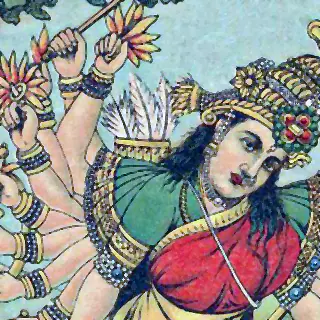
The Goddess beyond every softening — wild-haired, garlanded in defeated egos, dancing on time itself — and, her devotees insist, the most tender mother of them all.
Kali — Raja Ravi Varma / Ravi Varma Press, c. 1910
✦ In the simplest words
Kali Ma looks fierce — wild hair, dark as a storm-night, a tongue out and a garland that scares demons. But ask the people who love her: she is the mother who runs fastest when her child is in real danger. Her scary side faces the bad things; her lap faces you.
Why Kali Mata is God
Kali is the tradition's refusal to pretend. Time devours everything — every body, every empire, every star — and rather than paint over that truth, Sanatana Dharma made it a Mother and taught its children to climb into its lap. Her name is the feminine of kala: time, and blackness — the black that is not a colour but the womb of all colours, the state before and after every form. She is what remains when every mask is burnt, which is why her nakedness is called digambara — clothed in the directions themselves — and why her devotees say that only those willing to lose everything false can bear how much she loves them.
Bengal — her homeland of the heart — resolved the paradox generations ago in one word: Ma. Ramprasad and Ramakrishna quarrelled with her, sulked at her, sang to her as a small son to his mother, and reported the secret every Kali temple keeps: the terror is a door policy, not the interior. Ego cannot enter; grief can. She is worshipped at midnight, on new-moon nights, in cremation grounds — all the places polite religion avoids — because her promise operates exactly where all other reassurances end.
Origins — where the story begins
Her great scriptural birth is on a battlefield. In the Devi Mahatmya, as the demon generals Chanda and Munda advanced, Durga's calm face darkened with concentrated wrath — and from her furrowed brow sprang Kali, fully armed, gaunt with hunger for adharma, roaring loudly enough to shake the armies. She is anger itself given divine form: not the Mother losing control, but the Mother's control taking a form terrible enough for the task. She devoured the armies whole and brought the two generals' heads to Durga, earning the name Chamunda.
Deeper Shakta scripture reverses the arrow of origin: in tantric tradition and the Mahakala Samhita's world, Kali is Adyā — the primordial one — from whom Durga, Parvati and all forms shine like flames from one fire. Both truths are kept without embarrassment: born from Durga's brow in one text, mother of all the gods in another — because with Kali the tradition is describing what precedes description. The ten Mahavidyas, the tantric map of the Goddess's wisdoms, place her first.
Why they come
Kali is deployed where subtlety dies. Raktabija had a boon that made moderation useless: every drop of his spilled blood birthed a clone. Strategy, restraint, proportionate response — each only multiplied him. The universe needed a force willing to be excessive in dharma's cause, and Kali drank the problem at its source. That is her standing portfolio: addictions that regrow from every 'last time', fears that clone under negotiation, egos that feed on attention — Raktabija problems, all of them, and she is the tradition's honest admission that some things are not managed but ended. Her second work is grief: the Mother of endings sits with her children inside loss itself, which no gentle goddess can reach.
Every symbol, explained
The attributes the tradition gives them — and what each one means. Not every attribute appears in the painting above; all of them live in the temples and prints.
The dark of her skin
The night before creation and after it — all colours rest in her black.
Unbound hair
Nature without pruning — energy that answers to no social comb.
The garland of heads
Fifty heads for fifty letters: every ego she has severed, and the whole alphabet of creation worn as trophy and rosary at once.
The skirt of severed arms
Karma's instruments surrendered — she takes the doership from her devotees' hands.
The extended tongue
Read as her drinking Raktabija's flood, and in Bengal as her sudden shame at Shiva beneath her foot — ferocity and bashfulness in one gesture.
Shiva beneath her feet
Consciousness lying still under raging energy — the still floor that lets the dance end.
The tales of Kali Mata
The great stories, told in full — with their sources named. Use the arrows or pick a tale.
Raktabija — drinking the flood
Tale 1 of 4
Raktabija walked into battle already immortal in the cruellest way: wound him, and every drop of blood that touched earth stood up as another Raktabija. The Mothers struck him and made an army of him; the field filled with copies of the problem, each fully original. It is the scripture's picture of every self-replicating evil — rumour, addiction, hatred — that grows precisely by being fought.
Kali solved him with the totality that is her signature: she spread her tongue across the battlefield like the night sky rolling down, and as Durga's weapons opened the demon, she drank every drop before it landed. No seed, no soil, no second demon. The clones thinned; the original emptied; the field went quiet. The tradition's counsel hides in the method — some evils must never be given ground to touch: not one drop, not one 'just once', nothing to grow from.
Told in: Devi Mahatmya
What Kali Mata teaches
Stop feeding the clones
Raktabija grows from drops. With addictions and hatreds, the Kali method is totality at the source: no first drop, nothing to sprout from.
Look at what you fear to see
She stands in cremation grounds because truth lives where pretence dies. Whatever you cannot look at owns you; her darshan is the practice of looking.
Fierce love is still love
The surgeon's knife and the assailant's differ only in intention. Kali legitimises the love that says no, cuts off, ends — when protection requires it.
Put stillness in the storm's path
Shiva stopped the dance by lying down in it. Rage is not argued down; it is met by something utterly still and utterly loved — a breath, a name, a person.
Call her Ma
The whole secret of Kali bhakti in one syllable: approach the most frightening truth as a child approaches its mother, and its face changes for you.
How to learn from Kali Mata — this week
1
Choose your Raktabija — the habit that regrows from single drops — and practise source-totality for forty days: not one drop, with her name as the tongue that catches the rest.
2
Sit with one avoided truth a week — the unopened report, the overdue conversation, the mirror — as Kali darshan: look, breathe, don't flinch.
3
When anger dances in you past its work, lie a stillness in its path deliberately: ten So'ham breaths, or the face of someone you love, before any reply.
4
Keep one honest midnight a month — new-moon if you can — for japa of the Mother with nothing softened: your fears named to her directly.
Their names, and what they mean
Mahakalithe great Kali — time's own mother
Shyamathe dark beloved — Bengal's tender address
Chamundaslayer of Chanda and Munda
Bhavatarinishe who ferries across the ocean of becoming
Dakshina Kalithe benevolent form with the right foot forward
Adyāthe first — before all forms
Family & relations
She is Parvati-Durga's own ultimate intensity — born of Durga's brow in the Devi Mahatmya, first of the ten Mahavidyas in tantra, consort of Shiva as Mahakala. Bengal's affection gives her the whole family's tenderness: on Kali Puja night she is simply Ma, and every devotee is her child.
Their days
New-moon nights (Amavasya) are hers above all — Kali Puja falls on Diwali's amavasya — with Tuesdays and Saturdays kept for her in many Shakta homes.
These histories are retold faithfully from named scriptures and living tradition, and regional tellings are honoured where they differ. Like all religious content on Dharamkira, they await final review before public launch.