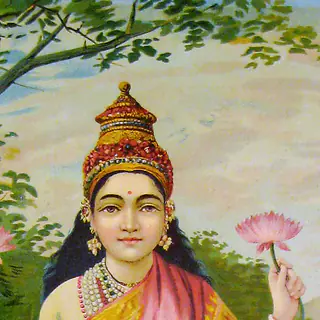
The white-clad goddess of knowledge, music and speech — the flowing river of the Vedas become the mother of every student, artist and seeker of clarity.
Goddess Saraswati — Raja Ravi Varma, 1896 painting; Ravi Varma Press print c. 1930
✦ In the simplest words
Saraswati Ma is the goddess of everything you learn — reading, music, art, speaking well. She wears white like a clean page, plays the veena, and rides a swan. Before exams and on Vasant Panchami, students keep their books near her and ask for a bright, clear mind.
Why Saraswati is God
She is the oldest goddess still worshipped by name: the Rig Veda hymns Saraswati as a mighty river and as inspired speech in the same breath, and that double birth never left her. Knowledge, the tradition says through her, is a flow — from teacher to student, generation to generation, thought to word — and it must keep moving or it stagnates. Everything about her murti refuses excess: white sari, no gold, a swan for a mount, a book, a mala, a veena. Wisdom, her form insists, needs no ornament; clarity is the beauty.
Her deepest instrument is speech itself: as Vagdevi she is the power by which sound carries meaning — the difference between noise and mantra, chatter and truth. Musicians tune to her before concerts; children write their first letters under her name in Kerala's Vidyarambham; the veena in her hands declares that knowledge, fully ripened, becomes art. And her swan performs the tradition's favourite miracle at every darshan: given milk mixed with water, the hamsa drinks only the milk — discrimination, viveka, pictured as a bird.
Origins — where the story begins
In the Vedic dawn she is the Saraswati river — 'best of mothers, best of rivers, best of goddesses', the water on whose banks the hymns themselves were heard. As the physical river faded into the desert (its palaeo-channels still traced today near the Ghaggar-Hakra), the goddess did not fade with it: the tradition understood that the true river had always been the flow of inspired knowledge, and she moved entirely into that current.
The Puranas tell her emergence at creation's own workbench: when Brahma shaped the cosmos, it lay mute and orderless until knowledge arose from him as a goddess — his shakti of speech and arrangement, sometimes called his daughter, whom the texts show teaching the creator the syllables by which creating becomes possible. The Puranas — the Matsya among them — and the beloved dhyana verse 'Ya kundendu...' fix her iconography: white as jasmine and moonlight, veena in hand, worshipped by Brahma, Vishnu and Shiva together — because gods too need wisdom before work.
Why they come
Saraswati's cosmic work is to make meaning possible. Creation without her is inventory; with her it becomes language, number, music, memory — a universe that can be understood and taught. She is the reason mantra works at all: sound joined to meaning with power. In human life her jurisdiction is the entire inner economy Lakshmi's coins cannot buy — attention, articulation, memory, taste. The tradition pairs and contrasts the two sisters-in-law with a smile: where Lakshmi's devotee asks 'what can I have?', Saraswati's asks 'what can I understand?' — and the old warning that the two rarely stay long in the same house is less a feud than a question posed to every household: what do you actually optimise for?
Every symbol, explained
The attributes the tradition gives them — and what each one means. Not every attribute appears in the painting above; all of them live in the temples and prints.
The white sari
Knowledge before opinion — the blank page's purity, sattva unmixed.
The veena
Learning matured into art; a mind tuned like strings — neither slack nor snapping.
The book and the mala
Two kinds of knowing held in balance: study and japa, information and realisation.
The hamsa (swan)
The bird said to drink milk out of watered milk — discrimination as a way of moving through the world.
The lotus seat on water
Thought poised on the flow — the river goddess still enthroned on her current.
The peacock nearby (in southern murtis)
Splendour kept at heel: art's glamour must serve wisdom, not rule it.
The tales of Saraswati
The great stories, told in full — with their sources named. Use the arrows or pick a tale.
Teaching creation to speak
Tale 1 of 4
Brahma had made the world, and the world was a warehouse: things beside things, none of them nameable, none of them related. The Purana says he grew bewildered at his own handiwork — what use is a cosmos that cannot be thought about? Then from his own concentration arose a goddess with a veena, and she began, simply, to teach: this sound for that thing; these sounds joined for that action; rhythm for time, melody for feeling, grammar for order.
As she spoke, the warehouse became a world. Stars acquired courses because sequence now existed; birds acquired song; the Vedas themselves, the tradition says, are her voice moving through the rishis. Vasant Panchami keeps the anniversary in yellow — mustard fields, spring's first alphabet — and its living custom completes the story: children are brought to write their first letters, because every first letter re-enacts the day meaning entered the world.
Told in: Matsya Purana; Puranic tradition
What Saraswati teaches
Drink the milk, leave the water
The hamsa's daily miracle is the study skill of the age: from every feed of information, separate nourishment from noise — then swallow.
Tune the string
Her veena plays only at right tension. Minds snap when overwound and buzz when slack — practice, rest and pace are musical decisions.
Knowledge grows by giving
She is a river, not a tank. The tradition's startling arithmetic — spent wealth shrinks, spent knowledge multiplies — makes teaching the best revision.
White before yellow
Approach every subject blank-paged first — opinions after understanding. Her white sari is a method, not a costume.
Honour your tools
Ayudha Puja for laptops and lab kits is not quaint: what you learn with deserves care, and cared-for tools teach back.
How to learn from Saraswati — this week
1
Open study with her: one recitation of 'Om Aim Saraswatyai Namah' or the Ya-kundendu verse, books touched to the forehead — a thirty-second ritual that changes the sitting's quality.
2
Practise hamsa-reading: for every article swallowed, write one line of milk — the single point worth keeping. The rest was water.
3
Teach weekly what you learn — a sibling, a classmate, a notebook if no one else. The river-rule: knowledge unclogged is knowledge multiplied.
4
Keep one Vasant Panchami promise a year: begin the thing you have been postponing — instrument, language, book — on her day, with yellow on the desk.
Their names, and what they mean
Sharadagoddess of the autumn brightness — Kashmir's own name for her
Vagdevigoddess of speech itself
Veena-panishe whose hands hold the veena
Hamsavahinirider of the swan of discrimination
Bharatithe eloquent one — a name India shares with her
Vidyadayinithe giver of learning
Family & relations
Consort of Brahma in the main Puranic stream — knowledge wedded to creation; in Bengal's affection she is also a daughter of the household of Durga, arriving each autumn beside Lakshmi, Ganesha and Kartikeya. Her true lineage, the texts smile, is every student who ever traced a first letter.
Their days
Vasant Panchami is her great day — spring's fifth, in yellow; Thursdays lean toward her as the guru's day, and Navratri's closing days seat her beside the Mothers.
These histories are retold faithfully from named scriptures and living tradition, and regional tellings are honoured where they differ. Like all religious content on Dharamkira, they await final review before public launch.