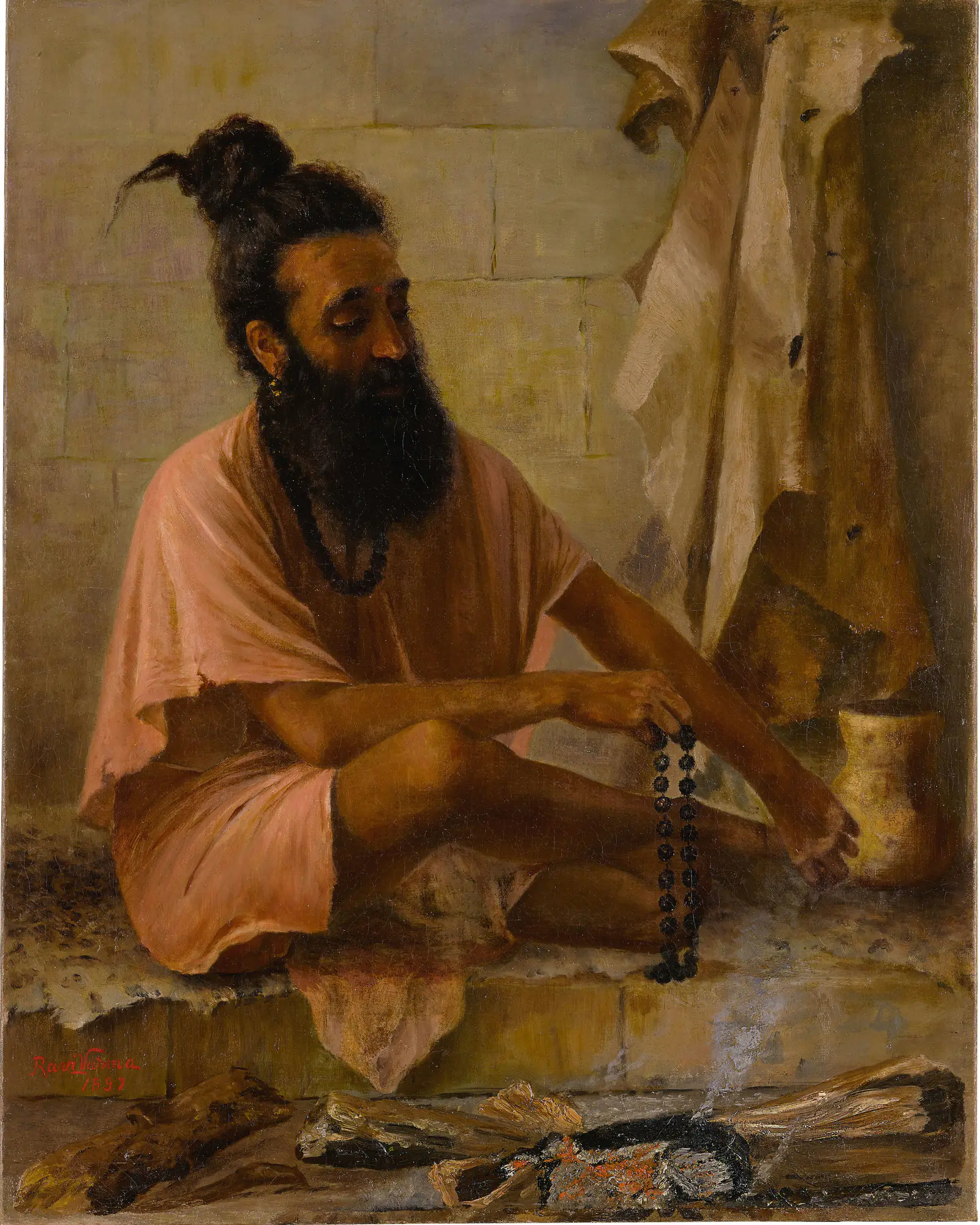
Mantra and japa
A sacred phrase, repeated with attention — usually 108 times, counted on a string of beads.
A mantra is a sound or phrase, usually in Sanskrit, held to carry power when repeated with attention. The traditional explanation of the word: that which protects (tra) the one who reflects on it (man). Some mantras are single seed-syllables — Om, Gam, Shreem. Some are names: "Om Namah Shivaya". Some are whole verses, like the Gayatri.
Japa is the repetition. It is counted on a mala of 108 beads, moved one by one with the thumb and middle finger; the larger bead at the end marks a completed round. Why 108? The tradition offers several explanations and no single agreed one, so treat it as the customary count, not a formula.
In the Gita, Krishna says: "Of offerings, I am the offering of japa" (10.25) — quiet repetition ranks with the grandest fire ritual.
How to start: choose one mantra, learn what it means, and repeat it eleven times a day for a week, aloud or silently, at the same time each day. Speed and volume do not matter; attention does. Every mantra on Dharamkira carries its Devanagari text, a simple pronunciation, its meaning, and a counter that keeps the tally for you.
In the tradition's words
महर्षीणां भृगुरहं गिरामस्म्येकमक्षरम् । यज्ञानां जपयज्ञोऽस्मि स्थावराणां हिमालयः ॥
maharṣīṇāṃ bhṛgur ahaṃ girām asmy ekam akṣaram, yajñānāṃ japa-yajño 'smi sthāvarāṇāṃ himālayaḥ
Of the great seers I am Bhrigu; of utterances, the single syllable; of offerings I am japa, the quiet repetition; of unmoving things, the Himalaya.
See it
Where this comes from
Traditional etymology: mananāt trāyate iti mantraḥ. Bhagavad Gita 10.25.