
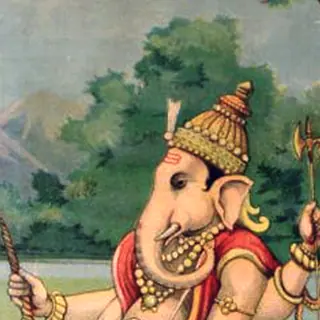
Ganesha
Ganesha Gayatri
ॐ एकदन्ताय विद्महे वक्रतुण्डाय धीमहि । तन्नो दन्ती प्रचोदयात् ॥
Simple reading
Om e-ka-dan-taa-ya vid-ma-he, vak-ra-tun-daa-ya dhee-ma-hi, tan-no dan-tee pra-cho-da-yaat
Oṁ ekadantāya vidmahe vakratuṇḍāya dhīmahi, tanno dantī pracodayāt
About this mantra
The Gayatri of Ganesha: the ancient Gayatri metre turned toward the single-tusked lord, asking him to kindle the intellect.
Meaning
We know the single-tusked one; we meditate on the curved-trunked one; may that Danti kindle our minds. Like every Gayatri it moves in three steps, knowing, meditating and being impelled: a whole method of practice folded into one metre. Ekadanta carries its own teaching. In the best-known telling, the broken tusk is the pen that wrote the Mahabharata, wholeness sacrificed for wisdom.
Learn it by heart
Say the first line until it comes without reading, then add the next line and say both, until the whole mantra comes on its own.
Line 1 of 2
ॐ एकदन्ताय विद्महे वक्रतुण्डाय धीमहि ।
Oṁ ekadantāya vidmahe vakratuṇḍāya dhīmahi, tanno dantī pracodayāt
0not said yet
Aim for eleven before the next line. Move on when the line comes without reading.
Progress stays on this device.
When to recite it
For sustained practice rather than a quick bow: morning sadhana, study seasons, and Chaturthi vrats. Traditionally counted in the early hours while the mind is still unclaimed.
Word by word
- एकदन्ताय विद्महेekadantāya vidmahe
- we know the single-tusked one
- वक्रतुण्डाय धीमहिvakratuṇḍāya dhīmahi
- we meditate on the curved-trunked one
- तन्नो दन्ती प्रचोदयात्tanno dantī pracodayāt
- may that Danti inspire us
Source: Gaṇapati Atharvaśīrṣa
Note: The Mahānārāyaṇa Upaniṣad (Taittirīya Āraṇyaka 10) gives an older form: 'tatpuruṣāya vidmahe vakratuṇḍāya dhīmahi, tanno dantiḥ pracodayāt'. The Gaṇapati Atharvaśīrṣa form with 'ekadantāya' and 'dantī' is used here.