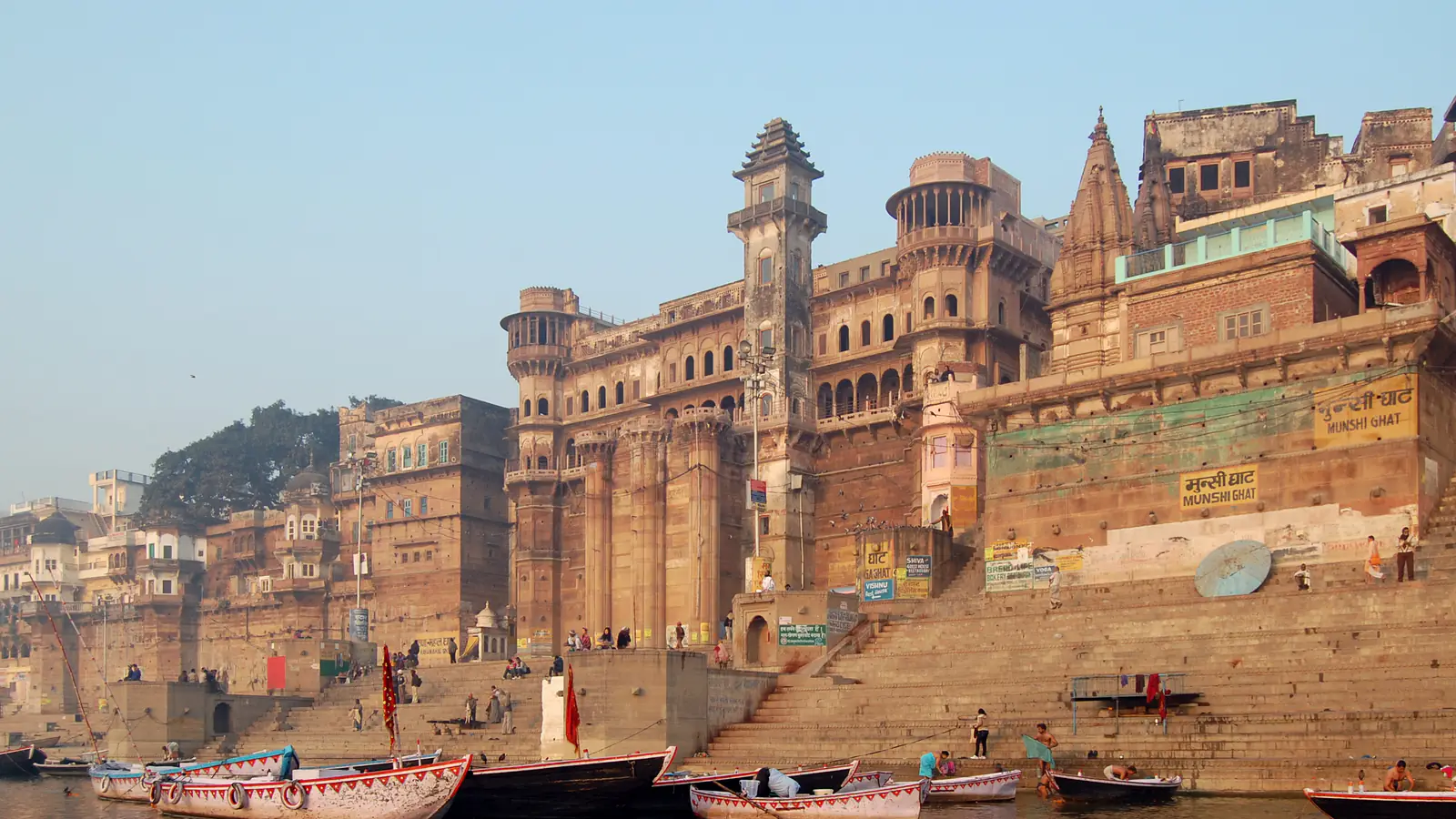
What Hinduism is
A family of traditions from India, more than three thousand years old, with no single founder, book, or church.
Hinduism is the name outsiders gave to the religious life of India. Many Hindus call it Sanatana Dharma, "the eternal way". It has no founder, no single scripture, and no central authority. It grew over thousands of years from the Vedas — its oldest texts, composed roughly 1500–1200 BCE — and from the temples, stories, and household customs of a whole subcontinent.
About 1.2 billion people are Hindu today, most in India and Nepal, with communities on every continent. They do not all believe or practise the same things. Scholars describe four broad streams: Vaishnava (centred on Vishnu), Shaiva (on Shiva), Shakta (on the Goddess), and Smarta (several deities honoured as forms of one reality). Within each, practice differs by region, language, and family.
What holds it together is a set of shared ideas and habits rather than a creed: dharma (right living), karma (action and its consequences), rebirth and liberation, respect for teachers and scriptures, and worship that happens at home as naturally as in a temple. Hinduism does not ask you to convert in order to learn from it. It asks you to begin.
In the tradition's words
एकं सद्विप्रा बहुधा वदन्ति
ekaṃ sad viprā bahudhā vadanti
That which is, is one; the wise speak of it in many ways.
See it
Where this comes from
Population: Pew Research Center, 2020 estimates. Vedic dating: the standard scholarly range. The four streams follow the grouping used in academic surveys of Hinduism (for example Gavin Flood, An Introduction to Hinduism, 1996).