
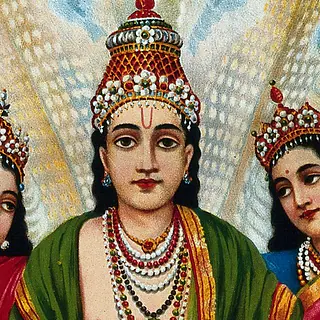
Vishnu
Shantakaram — Vishnu dhyana
शान्ताकारं भुजगशयनं पद्मनाभं सुरेशं विश्वाधारं गगनसदृशं मेघवर्णं शुभाङ्गम् । लक्ष्मीकान्तं कमलनयनं योगिभिर्ध्यानगम्यं वन्दे विष्णुं भवभयहरं सर्वलोकैकनाथम् ॥
Śāntākāraṁ bhujaga-śayanaṁ padmanābhaṁ sureśaṁ viśvādhāraṁ gagana-sadṛśaṁ megha-varṇaṁ śubhāṅgam, lakṣmī-kāntaṁ kamala-nayanaṁ yogibhir dhyāna-gamyaṁ vande viṣṇuṁ bhava-bhaya-haraṁ sarva-lokaika-nātham
Simple reading: Shaan-taa-kaa-ram bhu-ja-ga sha-ya-nam pad-ma-naa-bham su-re-sham, vish-vaa-dhaa-ram ga-ga-na sa-dri-sham me-gha var-nam shu-bhaan-gam, laksh-mee kaan-tam ka-ma-la na-ya-nam yo-gi-bhir dhyaa-na gam-yam, van-de vish-num bha-va bha-ya ha-ram sar-va lo-kai-ka naa-tham
About this mantra
The great meditation verse (dhyana-shloka) on Vishnu — serene on the serpent Shesha, lotus-naveled, cloud-dark, upholder of the universe. It has no single scriptural home; the puja manuals carry it as the standard Vishnu dhyana.
Meaning
I bow to Vishnu — of serene form, resting on the serpent, lotus-naveled, lord of the gods, support of the universe, vast as the sky, cloud-hued, of auspicious limbs; beloved of Lakshmi, lotus-eyed, reached by yogis in meditation; remover of the fear of worldly existence, the one lord of all the worlds. The verse builds its vision element by element — posture, navel, colour, eyes — until the mind has somewhere serene to stand. It asks for nothing: even 'remover of the fear of existence' is an epithet, not a plea. Its one verb is vande — I bow.
When to recite it
Recited to open Vishnu and Satyanarayana pujas, on Ekadashi mornings, and before sleep when the mind needs a serene image to rest on.
Word by word
- शान्ताकारंśāntākāraṁ
- of serene form
- भुजगशयनंbhujaga-śayanaṁ
- resting on the serpent (Shesha)
- पद्मनाभंpadmanābhaṁ
- lotus-naveled
- सुरेशंsureśaṁ
- lord of the gods
- विश्वाधारंviśvādhāraṁ
- support of the universe
- गगनसदृशंgagana-sadṛśaṁ
- vast as the sky
- मेघवर्णंmegha-varṇaṁ
- cloud-hued
- शुभाङ्गम्śubhāṅgam
- of auspicious limbs
- लक्ष्मीकान्तंlakṣmī-kāntaṁ
- beloved of Lakshmi
- कमलनयनंkamala-nayanaṁ
- lotus-eyed
- योगिभिर्ध्यानगम्यंyogibhir dhyāna-gamyaṁ
- reached by yogis in meditation
- वन्दे विष्णुंvande viṣṇuṁ
- I bow to Vishnu
- भवभयहरंbhava-bhaya-haraṁ
- remover of worldly fear
- सर्वलोकैकनाथम्sarva-lokaika-nātham
- the one lord of all the worlds
Source: Traditional Viṣṇu dhyāna-śloka (pooja paddhati corpus)